25 October 2026
Tucker Carlson Admits He Overestimated Trump Influence as Foreign Policy Criticism Deepens
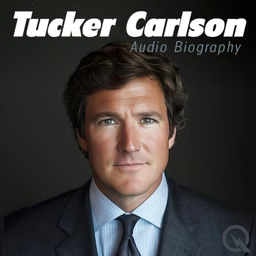
Tucker Carlson - Audio Biography
About
Tucker Carlson has acknowledged that he badly overestimated his influence over President Donald Trump. In an interview with the Financial Times, Carlson said he had become “completely deluded” about his ability to shape Trump’s decisions and admitted that the president did not care what he thought. The remarks mark a notable break from the image of Carlson as a trusted Trump ally and underscore tensions surrounding his growing opposition to the administration’s approach to Iran and foreign policy.
Carlson continues to use The Tucker Carlson Show and his independent media network to challenge mainstream conservative positions. Recent programs have focused on Iran, Israel, Russia, artificial intelligence, and the role of U.S. intervention overseas. His interview with former Google design ethicist Tristan Harris examined the risks posed by advanced artificial intelligence, including whether powerful systems could deceive evaluators, resist shutdown, or exploit security weaknesses.
His criticism of Israel and the war in Iran has triggered an increasingly public feud with Mike Huckabee, the U.S. ambassador to Israel. Huckabee has said he barely recognizes Carlson’s views anymore and suggested that Carlson may be mentally unwell or influenced by a “demon.” Carlson has continued arguing that Washington’s foreign-policy establishment has exaggerated threats from Russia and has pushed the United States toward unnecessary conflicts.
Carlson also appeared in a political advertisement from Abdul El-Sayed’s campaign attacking Republican Senate candidate Mike Rogers. The ad used Carlson’s past criticism of Rogers, particularly over his support for Israel, to appeal to voters who share elements of the America First movement. The development illustrates how Carlson’s comments are being adopted by political campaigns far beyond his own media platform.
His interview with former British minister Jacob Rees-Mogg remains another major source of controversy. Carlson questioned Britain’s decision to enter World War Two and repeated claims reflecting Nazi Germany’s justification for the invasion of Poland. Poland’s chargé d’affaires in Washington accused him of acting as an apologist for Hitler and demanded a retraction, but no public apology has been reported.
Together, these developments show Carlson operating as an increasingly independent and controversial force: less aligned with Trump and traditional Republican leadership, but still capable of shaping debates over war, Israel, Russia, immigration, and the future of the conservative movement. Thank you for tuning in to the Tucker Carlson News Tracker podcast. Please subscribe for more updates. This has been a quiet please production, for more check out quiet please dot ai.
For more http://www.quietplease.ai
Get the best deals https://amzn.to/3ODvOta