The path from warrior to king. Delivered Nov 23, 1986
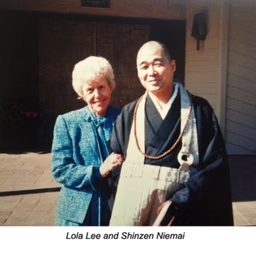
Talks by Zen Roshi, Lola McDowell Lee
Zen Roshi, Lola McDowell Lee, contrasts two fundamental inner orientations: the path of the warrior and the path of the king.
Lola shares Tilopa's poem to Naropa about transcending dualities, dissolving distractions, and abiding effortlessly in the natural state. She notes that while spiritual traditions are numerous, every individual ultimately carves out a unique path based on their own inner focus.
Lola categorizes human approaches into two basic stances: the aggressive, conflict-driven warrior and the dispassionate, observing king.
The history and philosophy of Gnosticism.
The warrior mindset. How early Egyptian monotheism blended with Greek and Jewish traditions, eventually producing a gloomy worldview dominated by dualistic conflict between an unknown, otherworldly God and a flawed material creator known as the Demi-urge. This duality manifested in early Christian history through two extreme reactions: asceticism, which viewed the physical body and matter as inherently evil and forbade procreation, and libertinism, which attempted to exhaust sensual appetites through indulgence.
The concept of the "Stranger God" -- a framework where humans are trapped between eternal forces of light and dark. Lola critiques this constant battle, arguing that we perpetually judge nature and itself through a rigid, fault-finding framework without recognizing the underlying unity of existence.
It is the mentality of a soldier versus the mentality of a monarch. A soldier is perpetually in the trenches, fighting enemies, obeying orders, and engaging in internal conflict to eradicate perceived flaws.
Conversely, a king does not battle; a king sits above the fray, observing calmly and overseeing the entire domain.
To illustrate this transition from warrior to king, Lola recounts the famous Zen encounter between Bodhidharma and an anxious Chinese emperor. When the emperor asked Bodhidharma to cure his mental disturbances, the master tells him to bring his anxieties to him at their next meeting so they could be healed.
Upon sitting in deep meditation to locate and confront his troubled thoughts, the emperor realizes that the anxieties had no independent substance—they existed only because he was not truly present as a witness.
Lola applies this insight directly to modern meditation practice, emphasizing the crucial importance of unshakeable attention and bare awareness. When distracting thoughts arise during meditation, practitioners typically make the mistake of either clinging to them, fighting them, or projecting blame outward.
The ego tends to disown negative thoughts while inflating the ego around positive thoughts.
True spiritual practice requires dropping this emotional reactivity and simply remaining the impartial witness. By observing thoughts as they come and go without attachment or aversion, the practitioner steps onto the royal road.
Ultimately, this leads to the realization of the non-attainable—resting in the silent, luminous space of the true, otherworldly self beyond all conceptual dualities.
Delivered Nov 23, 1986