zeno
Create a Station
Explore
Religious
Music
News
Podcasts
Bible
By Genre
By Location
By Language
Download App
Toggle Sidebar
zeno
Scientific American
Science Quickly
Science
English
Host Rachel Feltman, alongside leading science and tech journalists, dives into the rich world of scientific discovery in this bite-size science variety show.
Website
Episodes
300
05 June 2026
What’s in a name? When it comes to PCOS, a lot
In this episode of Science Quickly, host Rachel Feltman interviews physician Anuja Dokras about the long road to changing the name of the condition PCOS, or polycystic ovary syndrome, to polyendocrine metabolic ovarian syndrome, or PMOS. The conversation covers why “PCOS” was misleading, what the common condition actually involves and how an international group of researchers, including Dokras,...
15 min
03 June 2026
The math behind your daily annoyances
From the mystery of why elevator waits feel endless to the surprisingly tricky problem of splitting a pizza (or even a sandwich) fairly, this episode explores how math shapes everyday experiences in ways you might not expect. Host Rachel Feltman talks with physicist and editor Manon Bischoff about what hidden patterns lie behind daily frustrations, how shuffling a deck of cards involves...
13 min
01 June 2026
Why this Ebola outbreak is so different
In this episode of Science Quickly, host Rachel Feltman and Scientific American senior desk editor for health and medicine Tanya Lewis break down the fast-growing Ebola outbreak—caused by a viral species with no approved vaccine—in the Democratic Republic of the Congo and Uganda. And they explain why U.S. cuts to foreign aid and a sharp reversal in American policy are making a dangerous situation...
11 min
29 May 2026
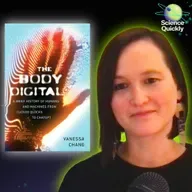
You think you’re using your phone. It’s using you back
In this episode of Science Quickly, author Vanessa Chang discusses her book The Body Digital: A Brief History of Humans and Machines from Cuckoo Clocks to ChatGPT. The book explores how technologies—from handwriting to smartphones and AI—don’t just extend human capability but subtly reshape our bodies, behaviors and relationships, raising urgent questions about connection, design and the meaning...
23 min
27 May 2026
Can we build a world that works for all?
In this episode of Science Quickly, host Rachel Feltman interviews leading thinker Jeremy Lent about his latest book Ecocivilization: Making a World That Works for All, which challenges the idea that humans are inherently selfish. Lent emphasizes our natural tendency toward cooperation and interconnectedness and proposes a shift to a new “operating system” based on these values. The conversation...
18 min
22 May 2026
The fake disease that fooled AI
Have you ever turned to an artificial intelligence chatbot for medical advice? In this episode of Science Quickly, host Rachel Feltman speaks with researcher Almira Osmanovic Thunström about an experiment in which she created “bixonimania,” a fake disease that AI chatbots easily absorbed and repeated to users. The experiment reveals the pitfalls of using AI to interpret medical results—a habit...
14 min
20 May 2026
Nukes on the moon?
In this episode of Science Quickly, host Rachel Feltman speaks with science journalist Robin George Andrews about NASA’s push to put a nuclear reactor on the moon. They explore why nuclear power could be key to sustaining long-term lunar missions, what the technical hurdles of operating a reactor in such an extreme environment are and why experts say the agency’s ambitious timeline may be moving...
16 min
18 May 2026
Hantavirus update, PCOS name change, ‘cheeky’ fish behavior
In this episode of Science Quickly, we get the latest on the hantavirus outbreak with Tanya Lewis, Scientific American’s senior desk editor for health and medicine. We also unpack why the common health condition previously named polycystic ovary syndrome, or PCOS, is now called polyendocrine metabolic ovarian syndrome, or PMOS. Then SciAm’s chief newsletter editor Andrea Gawrylewski shares an...
11 min
15 May 2026
Why Black women face a silent health crisis
In this episode of Science Quickly, gynecologic oncologist and health equity researcher Kemi Doll explains why the well-known Black maternal mortality crisis is part of a broader “Black womb crisis” in which many Black women experience a lifetime of gynecologic health challenges. Drawing on research and personal stories from her new book A Terrible Strength, Doll explores how Black women face...
15 min
13 May 2026
Do you actually need more protein? What the science says
Protein is having a major moment, showing up in everything from snack foods to coffee drinks—but do we actually need more of it? In this episode of Science Quickly, Rachel Feltman speaks with science journalist Bethany Brookshire about what has happened with the rise of the protein craze, how much protein people really need and why most of us are already getting plenty. They explore where the...
16 min