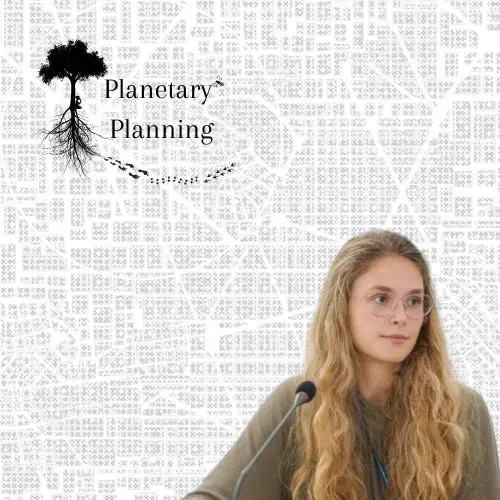
Exploring "Living Imaginaries", with Claudia Fernandez de Cordoba Farini
Planetary Planning Podcast
In this episode, Claudia Fernandez de Cordoba Farini joins us for an in-depth conversation about “Living Imaginaries”, how we can access alternative imaginaries that include more-than-humans, and several very concrete examples to ground this. Claudia is founder of “Living Imaginaries”, a social enterprise that combines bold imagination with grounded pathways for structural change. The enterprise works across climate, biodiversity, food, health, and justice as interconnected expressions of deeper political and economic systems. Its work spans research, policy, future-thinking, co-design, and strategy to advance governance rooted in care, equity, and more-than-human interdependence. She is also a PhD candidate at University College London and has an incredible series of relevant actions you can find out more about on her Linkedin profile!
In this Planetary Planning episode, Claudia shares some of what it can look like to challenge dominant imaginaries and envision alternatives, through examples from a project on re-imagining governance with the North Sea, the RIPPLE methodology, Claudia’s contribution to the Planetary Compendium, the Zoöp form of cross-species cooperation, and much more. Along this conversation we clarify how the term governance can be understood in this context, how more-than-humans can come into this, and even touch on relationships all this has with colonialism. We discuss methodologies in both our work experiences, and speak of the meaning of maintaining link to roots, even as we try to allow new imaginaries to emerge. Finally, we even briefly discuss the definitions of Planning as a field, and how closely this is related to Claudia’s work.
Take-aways for planners, by Claudia Fernandez de Cordoba Farini:
* Ask: How do we design cities that are for both humans and more-than-humans, where that design is thought beyond more construction, working with what is already there
* Re-imagine biodiversity governance through a more-than-human lens: how can you take the more-than-human approach in how you act in your own work?
Resources:
Many links are provided throughout the text above, but for ease of access and as an overview, I provide them here again:
Living Imaginaries social enterprise
Dark Matter Labs
Planetary Compendium
Zoop / The Zoonomic Institute
Fernandez de Cordoba Farini, C., Branca, F., Yoon, J.-H., Fan, S., Fanzo, J., Mercado, S. P., & Demaio, S. (2025). A centre of gravity: Asia–Pacific leadership in global food systems transformation. The Lancet Planetary Health, 9(10). https://doi.org/10.1016/j.lanplh.2025.101338
van Doorninck, W., Hermans, T., Molina, P. B., Minderhoud, K., Farini, C. F. D. C., Remans, R., & Karssenberg, M. (2025). Narrative analysis of biodiversity in food system transformation literature. https://edepot.wur.nl/700705
And for those interested in some of my own work that was mentioned in the episode a little too, here are some relevant links:
The MobileWorlds project - including toolkits of various applied methodologies, a library, and more
A critical commentary on (social) innovation: von Schönfeld, K. C., & Ferreira, A. (2021). Urban Planning and European Innovation Policy: Achieving Sustainability, Social Inclusion, and Economic Growth? Sustainability, 13(3), 1137. https://doi.org/10.3390/su13031137
My PhD thesis, mentioned in relation to the question of innovation, but also to the need for roots: von Schönfeld, K. C. (2021). Planning with Roots and Wings. Critical and constructive reflections on social learning in planning. Wageningen University / Proefschriftmaken. Available online: https://research.wur.nl/en/publications/planning-with-roots-and-wings-critical-and-constructive-reflectio/
This is a public episode. If you would like to discuss this with other subscribers or get access to bonus episodes, visit planetaryplanning.substack.com