08 November 2026
Permission to Feel: Reframe Your Inner Voice (with Marc Brackett Ph.D)
Neuroscience Meets Social and Emotional Learning
About
<p>In this episode Andrea Samadi revisits a conversation with Marc Brackett on recognizing and using emotions to improve learning, relationships, and performance. You’ll learn why the words we hear shape our self-talk, how vulnerability from adults opens space for others to share, and why reframing negative thoughts matters.</p>
<p>The episode includes a simple four-step practice—Notice, Question, Reframe, Act—plus practical examples for classrooms, sports, and the workplace to help listeners turn feelings into constructive action and stronger connections.</p>
<p>Welcome back to the <em>Neuroscience Meets Social and Emotional Learning Podcast</em>, where we bridge neuroscience, social and emotional learning, and human performance so we can create measurable improvements in our well-being, achievement, leadership, productivity, and results.</p>
<p>Welcome to Episode 411.</p>
<p>If you’re joining us for the first time—or following along with our <em>Journey of the Mind</em> roadmap—we’re exploring five phases that connect our understanding of the brain to how we learn, grow, and ultimately, how we perform.</p>
<p>We began with regulation and safety, explored neurochemistry and motivation, and then examined how movement supports learning and cognition.</p>
<p>Now, we’re in Phase 4: Perception, Emotion, and Social Intelligence, exploring how we interpret our experiences, understand our feelings, and connect with one another. These foundations will eventually lead us into Phase 5: Integration and Meaning.</p>
<p>In Episode 410<a href='#_edn1'>[i]</a>, we revisited our conversation with Lucy Biven to explore the biology of connection—why the support we offer may differ from the comfort someone actually feels, and how connection can help us become more open to learning.</p>
<p>Today, we take the next step: How do we recognize what we’re feeling, understand what those feelings are telling us, and respond in ways that strengthen our relationships and support our goals?</p>
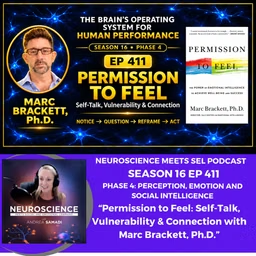
<p>In Episode 411 of <em>Neuroscience Meets Social and Emotional Learning</em>, we revisit my conversation with Marc Brackett, Ph.D., on <em>Permission to Feel</em>.</p>
<p></p>
<p>As we continue Phase 4, <em>Perception, Emotion & Social Intelligence</em>, we’ll learn:</p>
<p>✓ How other people’s words can become our self-talk and how to catch ourselves when one setback turns into a judgment about who we are.</p>
<p>✓ How to use a four-step routine to rethink a difficult thought. Notice what you’re telling yourself, question whether it’s fair, reframe it in a way you can believe, and take one manageable step.</p>
<p>✓ How a little vulnerability can open a conversation. We’ll hear why a parent saying, “I went through that too,” can make it easier for a child to talk about what they’re experiencing.</p>
<p>✓ How to apply these ideas in school, in sports, and at work, whether you’re helping a student ask for support, an athlete reset after a mistake, or a colleague speak up when they’re struggling.</p>
<p>To explore these questions, we’re revisiting Episode 22<a href='#_edn2'>[ii]</a> with Marc Brackett, Ph.D., recorded in September 2019, during the very first year of this podcast. His conversation remains among our Top 40 all-time interviews.</p>
<p>Marc is the founding director of the Yale Center for Emotional Intelligence<a href='#_edn3'>[iii]</a> and a professor in Yale’s Child Study Center. He is the author of <em>Permission to Feel</em> and, more recently, <em>Dealing with Feeling: Use Your Emotions to Create the Life You Want</em>.<a href='#_edn4'>[iv]</a> If you visit his website, you will see that he has recently launched a book club<a href='#_edn5'>[v]</a> to work closely with his second book.</p>
<p>When we first spoke, our conversation centered on <em>Permission to Feel</em>. Looking back through the lens of Phase 4, we can ask a deeper question: Once we give ourselves permission to feel, what do we do with those feelings?</p>
<p></p>
<p>That question connects our original interview to the work we’re doing today—understanding ourselves more clearly so we can connect with others and apply what we learn at school, at home, in sports, and in the workplace.</p>
<p>Let’s go back to 2019, and revisit Marc Brackett’s first book, <em>Permission to Feel</em>.</p>
<p><a href='https://www.youtube.com/shorts/uNkP9CHQJPE'>CLIP 1: “Whose Voice Is Defining You? From Negative Self-Talk to Constructive Reappraisal”</a></p>
<p>“One thing I say is that sadly for many children and adults, our self-views are defined by other people, so if you’re too short, or you’re too tall, or you’re too fat, or too skinny, or you’re too dark, or too light, or too feminine or too masculine, and the list goes on for what people can say to make you feel bad about yourself. It starts really young and children are highly impressionable, and vulnerable and I’ve seen this happen over and over again where people, and negative self-talk becomes rampant. Marc says—I always challenge parents and teachers and ask- how much time do you spend having students evaluate their self-talk and try to shift it to more positive self-talk or a reappraisal strategy.</p>
<p>In clip 1, Marc Brackett highlights how other people’s judgments can shape our self-image, beginning early in childhood. Comments about our appearance, identity, or differences can become an internal voice that influences how we see ourselves.</p>
<p>He challenges parents and teachers to help children examine that voice: What am I saying to myself—and is there a more constructive way to understand this situation? The same reflection can help adults, athletes, and workplace teams.</p>
<p>Key takeaways</p>
<ul>
Other people’s judgments can become our own self-talk. Notice when an internal criticism echoes something someone else has said.
A judgment is not a complete description of who we are. A label or difficult moment can overlook our strengths, circumstances, and capacity to grow.
Self-talk deserves deliberate attention. Alongside teaching skills and evaluating performance, make room to discuss how we speak to ourselves.
Reappraisal means considering another interpretation. It does not require pretending that something hurtful was acceptable. It means finding a perspective that is fairer, more accurate, and useful for deciding what to do next.
</ul>
<p>We have covered the power of positive thinking on many of our episodes over the years, but the one that stands out the most to me, is EP 191, PART 2 of our <em>Think and Grow Rich Study</em>, where we covered the power of our thoughts, from chapter 1 of Napoleon Hill’s <em>Think and Grow Rich</em>.</p>
<p>In Chapter 1 “The Power of Thought” Napoleon Hill talks about Edwin C. Barnes who also had a vision that he wanted to achieve when he “thought” his way into a partnership with Thomas Edison. Hill shares how Barnes had this burning desire to work with Thomas Edison. This was his goal, and was way out there for him, because he didn’t even know Edison, and was short on money to pay for his rail fare to get him to New Jersey to meet him. Barnes overcame all the obstacles he faced, and Edison recognized the look in his eyes and it’s what allowed him to eventually go into partnership with Barnes, who had no money, or influence to bring to the table, but he did have “initiative, faith and the will to win” (CH 1, page 4, TAGR) which was all Edison needed to see.</p>
<p>Barnes thought wildly differently to obtain what he wanted, and Edison picked up the energy or vibration that came from him, and it was easy for him to trust this was going to be a lucrative partnership, based on this feeling. And what he picked up was what Barnes actually thought of himself. It was obvious from the look in his eyes.</p>
<p>It matters what thoughts we think of ourselves. Our thoughts have the ability to drive us forward, like Barnes, or they will stop us fast before we can get anywhere close to where we want to go.</p>
<p>This is why Marc Brackett mentioned- I always challenge parents and teachers and ask- how much time do you spend having students evaluate their self-talk and try to shift it to more positive self-talk or a reappraisal strategy.</p>
<p>How to put this into practice</p>
<p></p>
<p>Use this simple routine on How to Rethink Your Self-Talk adapted from the clip:</p>
<p>Notice → Question → Reframe → Act.</p>
<p>1. Notice: “What am I telling myself? How does that thought actually make me feel?” Are my thoughts in line with where I want to go? My vision? I would take this further and say “are my thoughts, feelings and actions” lined up to where I want to go? My vision? If they are not, and if your self-talk shows any doubts, fears or even hesitation, towards where you want to go (your vision) you have some work to do.</p>
<p>Can you imagine if Barnes was afraid that maybe Edison would say no to his request to go into partnership with him, and his self-talk, or doubt, showed through to Edison in that very first meeting? Do you think Edison would have gone into partnership with Barnes if his self-doubt had shown through to him? Self-doubt is not something we can hide. You’re either confident, with an unwavering faith towards where you are going, or you are not. Notice how you feel. Do you notice anything that could prevent you from reaching your vision or end goal?</p>
<p>2. Question: To eliminate your negative self-talk ask yourself this question: “Is this a fact, someone’s opinion, or a conclusion I’m drawing? What evidence am I overlooking?” Once you investigate if what you are thinking is either true, or just a worry, you can begin to eliminate the thought.</p>
<p>I love how Dr. Daniel Amen talks about negative self-talk that he calls ANTS (automatic negative thinking) and he has a strategy to stop toxic thinking and literally rewire your brain<a href='#_edn6'>[vi]</a> with a process he calls “killing the ants” or to have “ant-eaters.” I think Dr. Amen developed this process for children, in the beginning, but anyone can understand and use his strategy. He describes ANTS as any thought that makes you “feel mad, sad, worried, nervous, lonely, or out of control.”<a href='#_edn7'>[vii]</a></p>
<p>Dr. Amen suggests:</p>
<ul>
To write down your negative thoughts to help get these thoughts on paper, and out of your head. We learned from Dr. Dan Seigel that this works by naming the negative thought, helps you to tame the negative thought.
Ask yourself if the thoughts is true, and he next suggests to reframe the thought, or turn it around by considering if the opposite of the thought could possibly be true. He then suggests to use this turnaround idea as a meditation.
</ul>
<p>He actually mentioned that “if you’re looking for antidepressant alternatives” he suggests that you look no further and use his Anteater Training. He said that “a 50 year retrospective study compared the impact of cognitive behavior therapy (which is what his anteater method is) to antidepressant medication (and) found that CBT is, on average, as effective as antidepressants”<a href='#_edn8'>[viii]</a> with an added bonus of the fact that CBT does not have the common side effects that accompany antidepressant medication. If one of the most famous American Psychiatrists suggests this method to reduce overwhelm, lift mood, strengthen relationships and create lasting emotional resilience, I’m definitely paying attention to a way to rewire my brain for improved happiness and positivity.</p>
<p>3. Reframing Our Self-Talk: Like Dr. Amen suggested, replace your judgment, or worry, or self-doubt with a specific, believable statement about yourself and what you really want. I’m sure that Barnes practiced asking Edison to partner with him a thousand times, before he built the confidence he needed to actually ask him in person.</p>
<p>I know we have talked about this in our <em>Think and Grow Rich Book</em> study that a part of achieving our goals is to not only WRITE out your goals, but to actually read them out loud. When I first started to read out my goals, I would close the windows because I was working on getting a grant for something I was working on, and I really did feel weird shouting it out that I was so grateful to be awarded this grant money. It took me saying it out loud for a few weeks until I could say it with confidence, and I did eventually open up the windows during this practice.</p>
<p>On EP 313<a href='#_edn9'>[ix]</a> we looked at how to reframe negative thinking with a review of Dr. Joe Dispenza’s programs. We looked at the power of our energy, understanding frequency, and how to use our mind to imagine our energy and thoughts, how to use our focus and concentrations to create stronger and more powerful thoughts.</p>
<p>We also dove into the importance of our thoughts when we covered the neuroscience of expectation on EP 333 as a part of our year-long study of Grant Bosnick’s <em>Tailored Approaches to Self-Leadership</em> book<a href='#_edn10'>[x]</a> The highlight of the episode was an in-depth exploration of the science of expectations, framed by Grant Bosnick and David Robson's book, <em>The Expectation Effect</em>. On this episode, we looked at the profound influence of positive and negative expectations on our daily life, mindset, goal achievement, and even health. </p>
<p>I can’t leave out EP 307<a href='#_edn11'>[xi]</a> with Dr. Konstantin Korotkov from Russia. This is one of my all-time favorite interviews because I loved how he helped us to understand tapping into the power of our thoughts, energy fields and intention by bridging science and the spiritual world. He reminded us that that we all have an energy field, we are all connected and “can influence each other.” </p>
<p>4. To Act: Choose one manageable next step, including asking for support from those around you, or in Barnes’ case, he just took action on what he wanted (the partnership with Edison) and didn’t waste time waiting around.</p>
<p>Setting</p>
<p>Notice the self-talk</p>
<p>Try a constructive reframe</p>
<p>Take action</p>
<p>School</p>
<p>“I’m not smart. I’ll never understand this.”</p>
<p>“I’m struggling with this skill. I can find out where I need help.”</p>
<p>Ask for a worked example, then practice one problem with feedback.</p>
<p>Sports</p>
<p>“I missed that shot. I’m a terrible player.”</p>
<p>“That play didn’t go how I wanted. I can reset and focus on the next one.”</p>
<p>Take a breath, use a familiar coaching cue, and return attention to the next play.</p>
<p>Workplace</p>
<p>“My idea was rejected. I have nothing valuable to contribute.”</p>
<p>“This proposal wasn’t accepted. I can ask what would make it stronger.”</p>
<p>Request specific feedback and identify one revision.</p>
<p>In the school example, we can learn anything, with the right instruction, eventually something that once escaped us, clicks, and we can understand it.</p>
<p>In the sports example, I always think of the quote by Michael Jordan, where he says “I missed more than 9000 shots in my career. I’ve lost almost 300 games. 26 times, I’ve been trusted to take the game-winning shot and missed. I’ve failed over and over again in my life. And that’s why I succeed.” (Basketball Player, Michael Jordan) He must have reframed each time he missed, and just kept trying again.</p>
<p>And for the workplace example, I think of Thomas Edison’s famous quote about the lightbulb when he said “I have not failed 10,000 –I’ve found 10,000 ways that (creating a light bulb) would not work.”</p>
<p>For teachers, coaches, and leaders: Model the process aloud: “That didn’t work as I hoped. Here’s what I learned, and here’s what I’ll try next.” Give feedback about specific behaviors and skills, and be aware put-downs that are impacting self-talk because as Marc Brackett mentioned, they stay with us for many years if we don’t address them. Supporting self-talk also means creating environments where people are treated with respect, and encouraged to try whether they get it right, or not.</p>
<p>A reflection for listeners: <em>Whose words are you carrying—and what would a fair, supportive coach help me say to myself today about these words? </em></p>
<p>This connects to Phase 4 by showing how our interpretation of an experience can influence our emotions, relationships, and next response. The goal is to develop an inner voice that helps us learn, recover from setbacks, and keep moving toward our goals.</p>
<p><a href='https://www.youtube.com/shorts/-M5zQ8iNNT0'>CLIP 2 | When Adults Open Up, Kids Know They Can Too</a></p>
<p>Summary</p>
<p>What might a child learn when the adults they trust only talk about the good things? In this clip, the speaker recalls fathers telling him they could never let their sons know they were bullied as children. He asks them to consider what their silence might communicate if their own child is being bullied. A simple, honest disclosure like “I went through that too” can give a child permission to talk about what’s happening and ask for help.</p>
<p>Key takeaways</p>
<ul>
Silence can send a message. When trusted adults rarely talk about fear, shame, or being hurt, kids may assume those experiences are supposed to stay private.
Share a little, then make room to listen. A brief personal story can open the conversation. Give the other person time to decide what they want to share.
How you respond matters. If someone takes the risk of telling you they’re struggling, thank them for trusting you and follow through on the support you offer.
</ul>
<p>How to put it into practice</p>
<p>Setting</p>
<p>What you can do</p>
<p>What it can sound like</p>
<p>Schools</p>
<p>If a student tells you privately that they’re being excluded or bullied, listen first, then agree on a next step and a time to check in.</p>
<p> </p>
<p>“I’m glad you told me. What’s been happening? Let’s talk about what would help you feel safer at school.”</p>
<p>Sports</p>
<p>Before a big game, or event share a brief example of a time you felt pressure and what helped you refocus. Give athletes an opening to talk one-on-one.</p>
<p>“I used to worry that I would trip at the starting line of a race. Waiting for the gun to go off would stress me out until I learned a strategy to focus on my breath and prepare for the start. What helps you to reset?”</p>
<p>Workplaces</p>
<p>In a team debrief, name a mistake you made and what you learned. Invite people to raise concerns early, then act on what they tell you.</p>
<p>“I waited too long to ask for help on this project. Where are we getting stuck now, and what support would help?”</p>
<p>A question for listeners: What’s one experience you could share that might make it easier for someone else to say, “I’m going through that too”?</p>
<p>I remember when I was working with teenagers in the classroom here in Arizona, on Character and Leadership, that students would always want to know when something didn’t go right for me, and how I handled it.</p>
<p>They would ask, “Miss, what happened that year that you didn’t get the grant funding. What did you do next?” I always remembered they didn’t want to know about the times things went smoothly, but when did I have to overcome adversity, and how did I press forward.</p>
<p>Episode Review</p>
<p>To review and conclude this week’s Episode 411, we learned from Marc Brackett that the words we hear from others can become the words we say to ourselves. We also learned that what we’re willing to talk about can shape what others feel comfortable sharing with us.</p>
<p>In our first clip, Marc challenged us to pay attention to our self-talk. When a setback turns into “I’m terrible at this,” try the four steps we covered today. Notice, Question, Reframe, and Act. Notice what you’re telling yourself. Ask whether it’s fair or accurate. Find a more believable way to describe what happened. Then take one manageable step. That might be asking for another example in class, resetting after a missed shot, or asking for feedback at work.</p>
<p>In our second clip, Marc asked us to imagine a father telling his child, “I was bullied when I was your age, too.” That one sentence could give the child an opening to say, “That’s happening to me.” What happens next is just as important. Does the adult give them time to talk? Do they listen and follow through to support them?</p>
<p>That’s how today’s episode fits into Phase 4 of our <em>Journey of the Mind</em>, Perception, Emotion, and Social Intelligence. In the first clip, we looked at how our interpretation of an experience can influence how we feel and what we do next. In the second, we saw how the way we respond to someone else’s feelings can influence whether they feel comfortable coming to us again. It takes us back to what Lucy Biven helped us see in Episode 410. There’s a difference between offering support and having someone actually feel supported.</p>
<p>And that brings us to Episode 412 on relationships with Greg Wolcott. We’ll revisit his work on <em>Significant 72</em> and ask what it looks like to build relationships deliberately, from the very first days of school. And we’ll take that question beyond the classroom. What can we do in the everyday moments on a team, at work, or at home to help someone feel known and know they can ask for support when things get hard?</p>
<p>Until then, think of one person you’d like to know better. Ask them a question you don’t already know the answer to. Give them time to answer, and the next time you see them, follow up on something they told you.</p>
<p>I’m Andrea Samadi. Thank you for listening, and I’ll see you next week for Episode 412 with Greg Wolcott.</p>
<p>RESOURCES</p>
<p>CLIP 1 <a href='https://www.youtube.com/shorts/uNkP9CHQJPE'>https://www.youtube.com/shorts/uNkP9CHQJPE</a></p>
<p>CLIP 2 <a href='https://www.youtube.com/shorts/-M5zQ8iNNT0'>https://www.youtube.com/shorts/-M5zQ8iNNT0</a></p>
<p>Original Interview with Marc Brackett EP 22 from September 2019 <a href='https://www.youtube.com/watch?v=CeOzi8ZrFO4'>https://www.youtube.com/watch?v=CeOzi8ZrFO4</a></p>
<p> </p>
<p>REFERENCES</p>
<p> </p>
<p><a href='#_ednref1'>[i]</a>Neuroscience Meets Social and Emotional Learning Podcast EP 410 <a href='https://andreasamadi.podbean.com/e/the-biology-of-support-how-connection-shapes-learning/'>https://andreasamadi.podbean.com/e/the-biology-of-support-how-connection-shapes-learning/</a></p>
<p> </p>
<p><a href='#_ednref2'>[ii]</a> Neuroscience Meets Social and Emotional Learning Podcast EP 22 <a href='https://andreasamadi.podbean.com/e/founding-director-of-the-yale-center-of-emotional-intelligence-on-his-new-book-permission-to-feel/'>https://andreasamadi.podbean.com/e/founding-director-of-the-yale-center-of-emotional-intelligence-on-his-new-book-permission-to-feel/</a></p>
<p> </p>
<p><a href='#_ednref3'>[iii]</a> <a href='http://ei.yale.edu/'>http://ei.yale.edu/</a></p>
<p> </p>
<p><a href='#_ednref4'>[iv]</a> <a href='https://contact.rulerapproach.org/dealing-with-feeling/'>https://contact.rulerapproach.org/dealing-with-feeling/</a></p>
<p> </p>
<p><a href='#_ednref5'>[v]</a> <a href='https://contact.rulerapproach.org/dealing-with-feeling/#book-clubs'>https://contact.rulerapproach.org/dealing-with-feeling/#book-clubs</a></p>
<p> </p>
<p><a href='#_ednref6'>[vi]</a> <a href='https://www.amenclinics.com/blog/number-one-habit-develop-order-feel-positive/'>https://www.amenclinics.com/blog/number-one-habit-develop-order-feel-positive/</a></p>
<p> </p>
<p><a href='#_ednref7'>[vii]</a> IBID</p>
<p> </p>
<p><a href='#_ednref8'>[viii]</a> IBID</p>
<p><a href='#_ednref9'>[ix]</a>Neuroscience Meets Social and Emotional Learning Podcast EP 313 <a href='https://andreasamadi.podbean.com/e/decoding-out-thoughts-how-to-build-a-better-future-with-the-power-of-our-mind-part-4-review-of-dr-joe-dispenza-s-work/'>https://andreasamadi.podbean.com/e/decoding-out-thoughts-how-to-build-a-better-future-with-the-power-of-our-mind-part-4-review-of-dr-joe-dispenza-s-work/</a></p>
<p> </p>
<p><a href='#_ednref10'>[x]</a>Neuroscience Meets Social and Emotional Learning Podcast EP 333 <a href='https://andreasamadi.podbean.com/e/exploring-the-power-of-expectations-in-episode-333/'>https://andreasamadi.podbean.com/e/exploring-the-power-of-expectations-in-episode-333/</a></p>
<p> </p>
<p><a href='#_ednref11'>[xi]</a> Neuroscience Meets Social and Emotional Learning Podcast 307 <a href='https://andreasamadi.podbean.com/e/dr-konstantinkorotkov-on-bridging-thespiritualworld-with-rigorousscientific-method-methodtappingintothe-powerof-our-thoughtsenergy-fieldsandlimitless/'>https://andreasamadi.podbean.com/e/dr-konstantinkorotkov-on-bridging-thespiritualworld-with-rigorousscientific-method-methodtappingintothe-powerof-our-thoughtsenergy-fieldsandlimitless/</a></p>
<p> </p>