09 May 2026
Why is Trump so fixated on Korea during the Iran war?
Korea JoongAng Daily - Daily News from Korea
About
This article is by Yoon Ji-won and read by an artificial voice.
Since the outbreak of the Iran war on Feb. 28, U.S. President Donald Trump has directly mentioned Korea on his social media a total of three times over the subsequent 70 days, pressing Seoul to commit troops.
The frequency is nearly on par with Germany, mentioned four times, against which Trump took retaliatory measures, including the withdrawal of 5,000 U.S. troops.
Expanding the scope to include White House press briefings and media interviews, Trump's pressure-laden references to Korea rise to ten occasions — roughly once a week — explicitly urging military support.
The implication is that, in Trump's strategic calculus, Korea — an East Asian ally — has been assigned a surprisingly significant role in the Middle East conflict.
Trump on March 14 demanded that Korea deploy naval assets and publicly remarked that "Korea did not help us" in a briefing in the White House on April 6.
More recently, he referenced the explosion incident involving the Korean cargo vessel HMM Namu in the Strait of Hormuz on Monday, stating that the Korean vessel "decided to act alone" and "the ships protected by the United States were not attacked."
Both within and beyond diplomatic circles, there is growing unease over what many describe as an extraordinary development: Washington attempting to draw Korea into a military conflict unfolding in the Middle East.
The immediate tensions eased only after Trump announced a temporary suspension of Project Freedom — the maritime rescue operation in the Strait of Hormuz. Yet diplomats caution that, depending on the trajectory of cease-fire negotiations, renewed demands for Korean troop deployment could resurface at any moment.
The Korean government in recent months has moved swiftly to shield itself from the Trump administration's tariff offensive while proving that the alliance remains, in Washington's terms, a "mutually beneficial partnership."
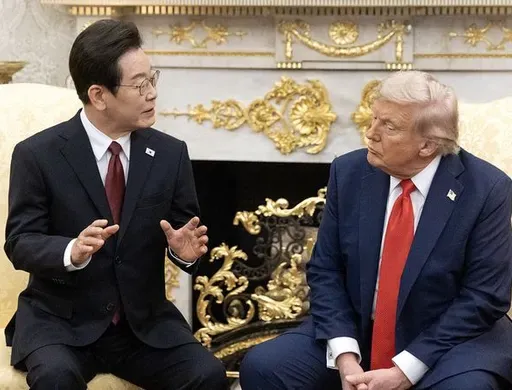
In the joint fact sheet released following the Korea-U.S. summit last November, President Lee Jae Myung agreed to raise defense spending from the current level — just under 3 percent of GDP — to 3.5 percent as early as possible.
Seoul's voluntary moves to raise defense spending and shoulder a greater share of the alliance burden have drawn favorable reviews across Washington's foreign policy establishment.
U.S. Defense Secretary Pete Hegseth on April 29 hailed Korea as a "model ally" over its decision to increase defense expenditures, adding that Seoul would receive special consideration from Washington.
The dynamic is also inseparable from Trump's deeply ingrained belief that U.S. allies habitually free ride on American security guarantees.
Throughout the Iran war, Trump repeatedly inflated the size of U.S. Forces Korea, currently around 28,500 troops, to 45,000 during public appearances, including a White House event on March 16, an Easter luncheon on April 1 and a press conference on April 6.
At the time, Trump openly vented his frustration, claiming that they have "45,000 people, soldiers in harm's way and right next to Kim Jong-un with a lot of nuclear weapons."
As such remarks continued to pile up, parts of the Korean government began dismissing them as little more than Trumpian bluster. During a closed-door meeting with a visiting bipartisan U.S. congressional delegation in Seoul on March 31, Lee reportedly asked if the United States was truly considering withdrawing from NATO.
The lawmakers immediately waved off the notion, adding "Never."
They pointed out that Congress had already amended the National Defense Authorization Act in late 2023, effectively preventing any president from unilaterally pulling the United States out of NATO without either a two-thirds Senate majority or separate congressional legislation.
Recent events involving Germany, however, have underscored how quickly Trump's pressure tactics can escalate from rhetoric into action.
After German Chancellor Friedrich Merz ment...
Since the outbreak of the Iran war on Feb. 28, U.S. President Donald Trump has directly mentioned Korea on his social media a total of three times over the subsequent 70 days, pressing Seoul to commit troops.
The frequency is nearly on par with Germany, mentioned four times, against which Trump took retaliatory measures, including the withdrawal of 5,000 U.S. troops.
Expanding the scope to include White House press briefings and media interviews, Trump's pressure-laden references to Korea rise to ten occasions — roughly once a week — explicitly urging military support.
The implication is that, in Trump's strategic calculus, Korea — an East Asian ally — has been assigned a surprisingly significant role in the Middle East conflict.
Trump on March 14 demanded that Korea deploy naval assets and publicly remarked that "Korea did not help us" in a briefing in the White House on April 6.
More recently, he referenced the explosion incident involving the Korean cargo vessel HMM Namu in the Strait of Hormuz on Monday, stating that the Korean vessel "decided to act alone" and "the ships protected by the United States were not attacked."
Both within and beyond diplomatic circles, there is growing unease over what many describe as an extraordinary development: Washington attempting to draw Korea into a military conflict unfolding in the Middle East.
The immediate tensions eased only after Trump announced a temporary suspension of Project Freedom — the maritime rescue operation in the Strait of Hormuz. Yet diplomats caution that, depending on the trajectory of cease-fire negotiations, renewed demands for Korean troop deployment could resurface at any moment.
The Korean government in recent months has moved swiftly to shield itself from the Trump administration's tariff offensive while proving that the alliance remains, in Washington's terms, a "mutually beneficial partnership."
In the joint fact sheet released following the Korea-U.S. summit last November, President Lee Jae Myung agreed to raise defense spending from the current level — just under 3 percent of GDP — to 3.5 percent as early as possible.
Seoul's voluntary moves to raise defense spending and shoulder a greater share of the alliance burden have drawn favorable reviews across Washington's foreign policy establishment.
U.S. Defense Secretary Pete Hegseth on April 29 hailed Korea as a "model ally" over its decision to increase defense expenditures, adding that Seoul would receive special consideration from Washington.
The dynamic is also inseparable from Trump's deeply ingrained belief that U.S. allies habitually free ride on American security guarantees.
Throughout the Iran war, Trump repeatedly inflated the size of U.S. Forces Korea, currently around 28,500 troops, to 45,000 during public appearances, including a White House event on March 16, an Easter luncheon on April 1 and a press conference on April 6.
At the time, Trump openly vented his frustration, claiming that they have "45,000 people, soldiers in harm's way and right next to Kim Jong-un with a lot of nuclear weapons."
As such remarks continued to pile up, parts of the Korean government began dismissing them as little more than Trumpian bluster. During a closed-door meeting with a visiting bipartisan U.S. congressional delegation in Seoul on March 31, Lee reportedly asked if the United States was truly considering withdrawing from NATO.
The lawmakers immediately waved off the notion, adding "Never."
They pointed out that Congress had already amended the National Defense Authorization Act in late 2023, effectively preventing any president from unilaterally pulling the United States out of NATO without either a two-thirds Senate majority or separate congressional legislation.
Recent events involving Germany, however, have underscored how quickly Trump's pressure tactics can escalate from rhetoric into action.
After German Chancellor Friedrich Merz ment...