04 August 2026
The military academy lost in 'Purple Clouds' (KOR) The military academy lost in 'Purple Clouds' (KOR) Related Article This article was originally written in Korean and translated by a bilingual reporter with the help of generative AI tools. It was then edited by a native English-speaking editor. All AI-assisted translations are reviewed and refined by our newsroom.
Korea JoongAng Daily - Daily News from Korea
About
Columns
Korea should strengthen military education with better funding, Seoul-area training and service-specific expertise rather than merging the academies.
Opinion Desk
Opinion
Desk
Published
August 4, 2026 - 9:33 a.m.
Modified
August 4, 2026 - 10:52 a.m.
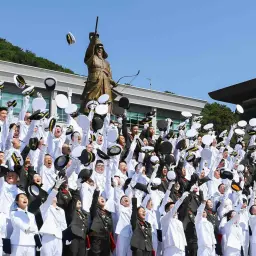
Newly commissioned Navy ensigns toss their service caps into the air and cheer at the commencement and commissioning ceremony for officer candidates of the Navy and Marine Corps on the grounds of the Naval Academy in Jinhae-gu, Changwon, South Gyeongsang, on May 28.
ROK Navy
Song Ho-keun
The author is a columnist at the JoongAng Ilbo, a chair professor and director of Doheon Academy, Hallym University.
On the night of April 21, 1951, Britain's Gloucestershire Regiment dug in on Mount Gamak in Paju to confront Chinese and North Korean troops crossing the Imjin River toward Seoul. Outnumbered, 750 soldiers fought until their final rounds. As Andrew Salmon recounted in "To the Last Round" (2009), their sacrifice bought time to establish a line at Mount Umyeon.
Defending the capital remains just as vital 75 years later. If an adversary advanced simultaneously through Goyang, Mia, and Guri, which of the Han River's 32 bridges would commanders destroy? That is not a question ChatGPT can answer. Lose the capital region in war and defeat is all but certain. Kyiv remains heavily fortified for precisely that reason. Yet do our future Army, Navy, and Air Force commanders know the terrain of the Seoul metropolitan area as instinctively as GPS?
Despite this, the service headquarters sit at the foot of Gyeryong Mountain in Chungnam, far removed from the pulse of modern society. Can future national security leaders sharpen their understanding of the nation while spending their formative years around Gyeryong Mountain? Military academies are not tools for balanced regional development.
Recently, defense officials and lawmakers signaled legislation to merge the three military academies under the banner of "integration," to be located at Jaundae — its name alone evokes drifting purple clouds. But blending soil, water, and sky makes little academic or tactical sense. Operations from World War II's Iwo Jima to the Chosin Reservoir succeeded because joint operations rested on deep, distinct domain expertise. In academia, interdisciplinary programs fail without foundational excellence in specific disciplines. Jointness cannot replace expertise.
Ultimately, military strength relies on one prerequisite: attracting outstanding young talent. If top students stop choosing the academies, national defense begins its decline.
Decades ago, military officers held high social standing. Today, online marriage rankings place officers near the bottom, only slightly above manufacturing workers at small enterprises. Between political controversies and a perceived loss of prestige, the profession has lost its luster.
Meanwhile, while leading civilian universities have seen budgets surge and facilities modernize, military academies resemble impoverished villages. The Korea Military Academy's 2026 education budget stands at 28.4 billion won ($20.5 million), with the Naval and Air Force academies at roughly 21 billion won each. While touted as high per-student expenditures due to specialized equipment, the campuses remain outdated, and faculty morale has withered. This is how the nation treats those willing to risk their lives for security — and we are told merger alone will fix it?
How, then, should we truly enhance jointness and military strength?
First, expand the Korea Military Academy campus in Taereung to establish a shared liberal arts curriculum for first- and second-year cadets from all three services. In their third year, cadets should move to Taereung, Jinhae or Cheongju for specialized training, introducing joint operations tracks later in their early officer careers.
Second, allocate funding commensurate with the value of national security to attract top-tier cadets and faculty.
Over the past four...
Korea should strengthen military education with better funding, Seoul-area training and service-specific expertise rather than merging the academies.
Opinion Desk
Opinion
Desk
Published
August 4, 2026 - 9:33 a.m.
Modified
August 4, 2026 - 10:52 a.m.
Newly commissioned Navy ensigns toss their service caps into the air and cheer at the commencement and commissioning ceremony for officer candidates of the Navy and Marine Corps on the grounds of the Naval Academy in Jinhae-gu, Changwon, South Gyeongsang, on May 28.
ROK Navy
Song Ho-keun
The author is a columnist at the JoongAng Ilbo, a chair professor and director of Doheon Academy, Hallym University.
On the night of April 21, 1951, Britain's Gloucestershire Regiment dug in on Mount Gamak in Paju to confront Chinese and North Korean troops crossing the Imjin River toward Seoul. Outnumbered, 750 soldiers fought until their final rounds. As Andrew Salmon recounted in "To the Last Round" (2009), their sacrifice bought time to establish a line at Mount Umyeon.
Defending the capital remains just as vital 75 years later. If an adversary advanced simultaneously through Goyang, Mia, and Guri, which of the Han River's 32 bridges would commanders destroy? That is not a question ChatGPT can answer. Lose the capital region in war and defeat is all but certain. Kyiv remains heavily fortified for precisely that reason. Yet do our future Army, Navy, and Air Force commanders know the terrain of the Seoul metropolitan area as instinctively as GPS?
Despite this, the service headquarters sit at the foot of Gyeryong Mountain in Chungnam, far removed from the pulse of modern society. Can future national security leaders sharpen their understanding of the nation while spending their formative years around Gyeryong Mountain? Military academies are not tools for balanced regional development.
Recently, defense officials and lawmakers signaled legislation to merge the three military academies under the banner of "integration," to be located at Jaundae — its name alone evokes drifting purple clouds. But blending soil, water, and sky makes little academic or tactical sense. Operations from World War II's Iwo Jima to the Chosin Reservoir succeeded because joint operations rested on deep, distinct domain expertise. In academia, interdisciplinary programs fail without foundational excellence in specific disciplines. Jointness cannot replace expertise.
Ultimately, military strength relies on one prerequisite: attracting outstanding young talent. If top students stop choosing the academies, national defense begins its decline.
Decades ago, military officers held high social standing. Today, online marriage rankings place officers near the bottom, only slightly above manufacturing workers at small enterprises. Between political controversies and a perceived loss of prestige, the profession has lost its luster.
Meanwhile, while leading civilian universities have seen budgets surge and facilities modernize, military academies resemble impoverished villages. The Korea Military Academy's 2026 education budget stands at 28.4 billion won ($20.5 million), with the Naval and Air Force academies at roughly 21 billion won each. While touted as high per-student expenditures due to specialized equipment, the campuses remain outdated, and faculty morale has withered. This is how the nation treats those willing to risk their lives for security — and we are told merger alone will fix it?
How, then, should we truly enhance jointness and military strength?
First, expand the Korea Military Academy campus in Taereung to establish a shared liberal arts curriculum for first- and second-year cadets from all three services. In their third year, cadets should move to Taereung, Jinhae or Cheongju for specialized training, introducing joint operations tracks later in their early officer careers.
Second, allocate funding commensurate with the value of national security to attract top-tier cadets and faculty.
Over the past four...