03 April 2026
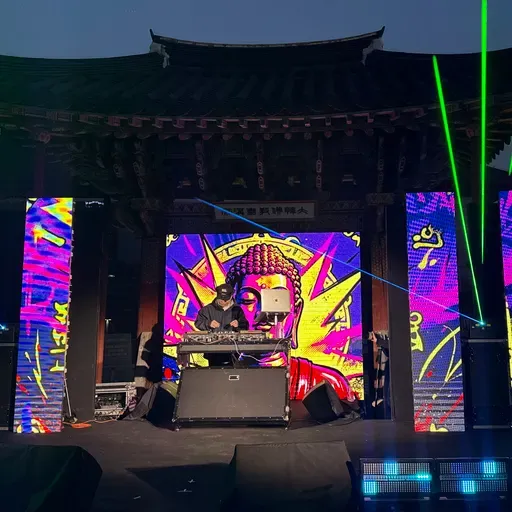
Merch and EDM shows: Seoul Buddhist expo repackages ancient faith as lifestyle brand
Korea JoongAng Daily - Daily News from Korea
About
This article is by Woo Ji-won and read by an artificial voice.
Judging by the number of preregistered visitors, which surpassed 50,000 for the first time, as well as the substantial crowds seen at the 14th edition of the expo in Gangnam District, southern Seoul, on Thursday — which runs through Sunday — the approach appears to be working.
Even before the gates opened at 10 a.m., a large crowd had already formed. By early afternoon, the venue — home to 430 booths — was so packed that visitors could barely move without brushing past one another. The young women were the most visible.
Buddha — a new aesthetic motif
Much of the expo's appeal lay in how Buddhist concepts were translated into everyday experiences, drawing even from K-pop culture.
At one corner, visitors sipped lotus lattes in Buddha-themed cup holders, posing beside a life-size Buddha standee while holding "photo cards" featuring the Buddha that came with their drinks — just like at a K-pop idol birthday cafe, where fans decorate the space with photos and goods to throw a birthday party for their favorite star.
Photo cards, a staple of K-pop fandom, are small, collectible cards bearing the photos of entertainers.
But the real crowd magnets for young people were the merchandise booths, where Buddhist ideas and symbols were reinterpreted through modern design — often in playful, humorous ways that resonated with everyday life.
Haetal Company, a brand founded by the daughter and son of Venerable Taehyeon, a Buddhist monk, offered everything from key-cab key rings and stickers to towels and underwear, incorporating stylized Buddha imagery and messages of calm and self-reflection. Its denim monk pants sold out by midafternoon.
This shift toward "lifestyle Buddhism" was also evident in booths that were less expected to find it. A crowd gathered around a booth selling moktak — wooden percussion instruments traditionally used by monks — as they lined up to test each one and find their preferred sound.
"No two trees are the same, and because each piece is handcrafted, no two moktak sound alike, just like people," said Ahn Jin-seok, owner of the Yeongcheon Moktak.
"Until about three years ago, visitors in their 40s to 60s made up around 70 percent. But now, people in their 20s and 30s account for nearly 70 percent." The shift, he added, reflects rising interest in self-discipline and mental well-being among young people, with even non-Buddhists and temple-goers purchasing moktak for personal use.
That same curiosity extended to other booths offering temple-inspired scents, meditation books and art, which played a role in reshaping perceptions.
"I draw Buddhist illustrations in a fairytale-like style, hoping they can reach people in a warmer and friendlier way," said artist Kim Baek-seoul. "My work conveys that the Buddha exists within us. That I, too, can be a Buddha."
Buddhism meets everyday concerns
Beyond merchandise and branding, the expo also created opportunities for visitors to engage with Buddhism in ways closely tied to their everyday lives.
Venerable Haeyoung offered guidance on topics ranging from personal concerns to philosophical questions about gong, or emptiness. The appeal laid in the accessibility of engaging with Buddhist thought in a casual, open-ended way.
Reflecting the concerns of many young visitors, particularly women, Venerable Yeonwoo offered physiognomy readings, dubbed "plastic surgery consultations," which drew long lines.
"I asked whether I could improve my fortune through makeup instead of plastic surgery," said Moon Chae-young, a 25-year-old who attended the event with a friend. "The monk said everything was good overall, but that my nose was 'weak,' meaning my back or heart could be weak. She advised me to breathe with my mouth closed so that good energy comes in and bad energy goes out."
Moon, who is not Buddhist, said that while the consultation was comforting, the expo itself also exceeded her expectations. "Being here feels heali...
Judging by the number of preregistered visitors, which surpassed 50,000 for the first time, as well as the substantial crowds seen at the 14th edition of the expo in Gangnam District, southern Seoul, on Thursday — which runs through Sunday — the approach appears to be working.
Even before the gates opened at 10 a.m., a large crowd had already formed. By early afternoon, the venue — home to 430 booths — was so packed that visitors could barely move without brushing past one another. The young women were the most visible.
Buddha — a new aesthetic motif
Much of the expo's appeal lay in how Buddhist concepts were translated into everyday experiences, drawing even from K-pop culture.
At one corner, visitors sipped lotus lattes in Buddha-themed cup holders, posing beside a life-size Buddha standee while holding "photo cards" featuring the Buddha that came with their drinks — just like at a K-pop idol birthday cafe, where fans decorate the space with photos and goods to throw a birthday party for their favorite star.
Photo cards, a staple of K-pop fandom, are small, collectible cards bearing the photos of entertainers.
But the real crowd magnets for young people were the merchandise booths, where Buddhist ideas and symbols were reinterpreted through modern design — often in playful, humorous ways that resonated with everyday life.
Haetal Company, a brand founded by the daughter and son of Venerable Taehyeon, a Buddhist monk, offered everything from key-cab key rings and stickers to towels and underwear, incorporating stylized Buddha imagery and messages of calm and self-reflection. Its denim monk pants sold out by midafternoon.
This shift toward "lifestyle Buddhism" was also evident in booths that were less expected to find it. A crowd gathered around a booth selling moktak — wooden percussion instruments traditionally used by monks — as they lined up to test each one and find their preferred sound.
"No two trees are the same, and because each piece is handcrafted, no two moktak sound alike, just like people," said Ahn Jin-seok, owner of the Yeongcheon Moktak.
"Until about three years ago, visitors in their 40s to 60s made up around 70 percent. But now, people in their 20s and 30s account for nearly 70 percent." The shift, he added, reflects rising interest in self-discipline and mental well-being among young people, with even non-Buddhists and temple-goers purchasing moktak for personal use.
That same curiosity extended to other booths offering temple-inspired scents, meditation books and art, which played a role in reshaping perceptions.
"I draw Buddhist illustrations in a fairytale-like style, hoping they can reach people in a warmer and friendlier way," said artist Kim Baek-seoul. "My work conveys that the Buddha exists within us. That I, too, can be a Buddha."
Buddhism meets everyday concerns
Beyond merchandise and branding, the expo also created opportunities for visitors to engage with Buddhism in ways closely tied to their everyday lives.
Venerable Haeyoung offered guidance on topics ranging from personal concerns to philosophical questions about gong, or emptiness. The appeal laid in the accessibility of engaging with Buddhist thought in a casual, open-ended way.
Reflecting the concerns of many young visitors, particularly women, Venerable Yeonwoo offered physiognomy readings, dubbed "plastic surgery consultations," which drew long lines.
"I asked whether I could improve my fortune through makeup instead of plastic surgery," said Moon Chae-young, a 25-year-old who attended the event with a friend. "The monk said everything was good overall, but that my nose was 'weak,' meaning my back or heart could be weak. She advised me to breathe with my mouth closed so that good energy comes in and bad energy goes out."
Moon, who is not Buddhist, said that while the consultation was comforting, the expo itself also exceeded her expectations. "Being here feels heali...