About
For 11 years, she navigated village forestry
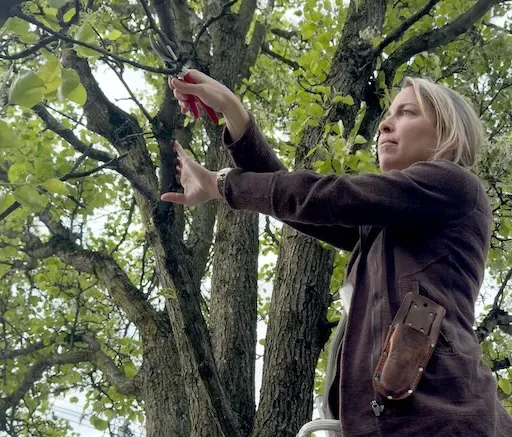
Jennifer Zwarich has had a thing for trees for a long time.
"I've always been a tree person, although I'm not a tree hugger, exactly," she said. "I was a tree climber as a kid and trees always made me feel small in a good way."
On Arbor Day (April 25), Zwarich stepped down as chair of the Cold Spring Tree Advisory Board, a role she took on before the panel was created 11 years ago.
In 2012, a handful of volunteers formed the Shady Lane Campaign to tend to village-owned trees. A year later, the Village Board appointed an ad hoc committee to investigate whether a tree board and local tree law were needed.
When Zwarich wrote Mary Saari, then the village clerk, to volunteer, Saari replied, "Would you like to chair the committee?"
Zwarich soon learned that even tree care can become political. What was supposed to be four quick meetings and a recommendation to the Village Board became much more. A session at Butterfield library drew a passionate crowd. Some vehemently opposed forming a committee. "It was baffling to me," Zwarich recalled.
A subsequent meeting at Village Hall also got boisterous. "About 30 people fought for almost an hour over whether to call it a board, a committee or a commission," Zwarich said. (She says now that "board" was the right choice because it carries weight and helped her secure nearly $100,000 in grants.)
Looking back, she feels some who opposed the committee felt it would be another layer of government, taking money from the budget. There was also concern that a tree law could infringe on private property rights, although the board only deals with village-owned trees.
After the dust settled in 2015, the board added "Chapter 122: Trees" to the Village Code, and a Tree Advisory Board was established, with Zwarich as chair.
An initial survey found the village owned about 500 trees, she said. "Our goal was to plant many more trees than we were losing," she said. Since the board was created, volunteers and Highway Department staff have planted about 230 trees, and 592 have been inventoried by species (72) and condition.
Zwarich said that while residents seem to love them or hate them, the Main Street tree pits were her favorite project. "They have improved the health of a lot of trees," she said, although some need weeding. She views that as "an invitation for volunteer-minded people and businesses to get involved."
Village-Owned Trees
Norway maple (50)*
Callery pear (48)
Black oak (32)
Red maple (32)
Honey locust (30)
Zelkova (22)
Cherry (21)
Serviceberry (20)
Black gum (19)
Oak (16)
Pin oak (16)
Black locust (15)*
Sugar maple (15)
Plum (14)
Gingko (13)
Linden (13)
Japanese tree (12)
Silver maple (11)
Sweetgum (11)
Eastern red (10)
London (10)
*New York invasive species
Urban forestry can be challenging. "The sidewalk strip is not a place for trees; they're growing in awful conditions most of the time and getting peed on," she said. In addition, many side streets lack tree cover because there's no space to plant on village property. "The oldest trees are all on private property, where they have more rooting space," she said.
Zwarich noted that in some places, such as Rhinebeck, the municipality donates and maintains trees near sidewalks that are on private property. "I don't know if it would fly here, but that's the next frontier," she said.
She believes most people know trees are good for the environment, giving off oxygen, taking in carbon dioxide and reducing pollution. But she said the economic benefits are overlooked. "Shading your house can reduce your summer electrical bill, and the increase in property values by having trees around your house or in your neighborhood is huge."
She said that when the tree committee was created, the village forest lacked diversity, including an overabundance of Norway maples, which grow fast. "They ended up being a real problem," Zwarich said. "They're weak-wooded and brittle and shed branches during storms," creating ...
Jennifer Zwarich has had a thing for trees for a long time.
"I've always been a tree person, although I'm not a tree hugger, exactly," she said. "I was a tree climber as a kid and trees always made me feel small in a good way."
On Arbor Day (April 25), Zwarich stepped down as chair of the Cold Spring Tree Advisory Board, a role she took on before the panel was created 11 years ago.
In 2012, a handful of volunteers formed the Shady Lane Campaign to tend to village-owned trees. A year later, the Village Board appointed an ad hoc committee to investigate whether a tree board and local tree law were needed.
When Zwarich wrote Mary Saari, then the village clerk, to volunteer, Saari replied, "Would you like to chair the committee?"
Zwarich soon learned that even tree care can become political. What was supposed to be four quick meetings and a recommendation to the Village Board became much more. A session at Butterfield library drew a passionate crowd. Some vehemently opposed forming a committee. "It was baffling to me," Zwarich recalled.
A subsequent meeting at Village Hall also got boisterous. "About 30 people fought for almost an hour over whether to call it a board, a committee or a commission," Zwarich said. (She says now that "board" was the right choice because it carries weight and helped her secure nearly $100,000 in grants.)
Looking back, she feels some who opposed the committee felt it would be another layer of government, taking money from the budget. There was also concern that a tree law could infringe on private property rights, although the board only deals with village-owned trees.
After the dust settled in 2015, the board added "Chapter 122: Trees" to the Village Code, and a Tree Advisory Board was established, with Zwarich as chair.
An initial survey found the village owned about 500 trees, she said. "Our goal was to plant many more trees than we were losing," she said. Since the board was created, volunteers and Highway Department staff have planted about 230 trees, and 592 have been inventoried by species (72) and condition.
Zwarich said that while residents seem to love them or hate them, the Main Street tree pits were her favorite project. "They have improved the health of a lot of trees," she said, although some need weeding. She views that as "an invitation for volunteer-minded people and businesses to get involved."
Village-Owned Trees
Norway maple (50)*
Callery pear (48)
Black oak (32)
Red maple (32)
Honey locust (30)
Zelkova (22)
Cherry (21)
Serviceberry (20)
Black gum (19)
Oak (16)
Pin oak (16)
Black locust (15)*
Sugar maple (15)
Plum (14)
Gingko (13)
Linden (13)
Japanese tree (12)
Silver maple (11)
Sweetgum (11)
Eastern red (10)
London (10)
*New York invasive species
Urban forestry can be challenging. "The sidewalk strip is not a place for trees; they're growing in awful conditions most of the time and getting peed on," she said. In addition, many side streets lack tree cover because there's no space to plant on village property. "The oldest trees are all on private property, where they have more rooting space," she said.
Zwarich noted that in some places, such as Rhinebeck, the municipality donates and maintains trees near sidewalks that are on private property. "I don't know if it would fly here, but that's the next frontier," she said.
She believes most people know trees are good for the environment, giving off oxygen, taking in carbon dioxide and reducing pollution. But she said the economic benefits are overlooked. "Shading your house can reduce your summer electrical bill, and the increase in property values by having trees around your house or in your neighborhood is huge."
She said that when the tree committee was created, the village forest lacked diversity, including an overabundance of Norway maples, which grow fast. "They ended up being a real problem," Zwarich said. "They're weak-wooded and brittle and shed branches during storms," creating ...