Send us Fan Mail
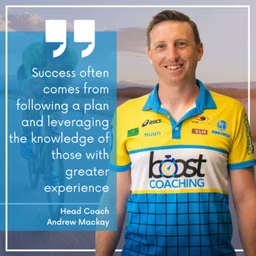
For this episode of the SwimScape Podcast, we sit down with Andrew Mackay, founder and Head Coach of Auckland-based Boost Coaching.
Andrew’s own journey in endurance sport started in the swimming pool. A competitive swimmer at national level as a youngster, he eventually made the transition into triathlon — going on to race professionally between 2006 and 2009 and ultimately lining up in the professional field at the 2009 Ironman World Championship in Hawaii.
But perhaps the most interesting part of Andrew's story isn't what he achieved as a professional athlete.
It's what he has learned since.
Today, Andrew coaches a wide range of athletes — from people taking on their first endurance event through to experienced Ironman and triathlon competitors. And as a father of two boys, he understands the reality of trying to train seriously while also being a parent, running a business and managing everything else that life throws at you.
His philosophy is refreshingly realistic: there isn't a perfect work-life-training balance. The balance changes.
Sometimes training gets priority. Sometimes work does. Sometimes family has to come first. And sometimes you simply have to accept that you're not superhuman.
That philosophy seems to sit at the heart of what Andrew does at Boost Coaching - helping athletes build effective training around their actual lives, rather than expecting their lives to revolve entirely around training.
And then there's swimming...
Andrew has developed "The Seven Secrets to Swimming Success", a resource aimed at helping swimmers and triathletes understand why they may be struggling in the water and, more importantly, what they can do about it.
In this episode, we'll unpack those seven secrets, including:
1. There is a LOT going on in a swim stroke
Understanding the sequence of movement and breaking technique down into manageable pieces.
2. Cause and effect matters
Why fixing one part of your stroke often requires looking at something else happening earlier in the movement.
3. Swimming is dynamic
Why drills are useful, but ultimately swimming needs to become a continuous, rhythmic and flowing movement.
4. Tension kills technique
Learning the difference between swimming hard and swimming efficiently.
5. Adults can relearn coordination
Why many adult swimmers overthink the process — and how patience, repetition and the right drills can make a huge difference.
6. Breathing isn't optional — but panic is
Finding a relaxed breathing rhythm and developing confidence in the water.
7. Your feet matter
Understanding the role of kicking, body position, rotation and the kinetic chain in creating an efficient freestyle stroke.
These principles are part of the swimming philosophy Andrew applies through Boost Coaching, alongside structured training, accountability and a personalised approach to the individual athlete.
From national-level swimmer, to professional triathlete, to Ironman World Championship competitor, to coach and father of two. This is about much more than getting faster in the water. It’s about figuring out how to keep moving forward when real life is happening around you.