Support the show to get full episodes, full archive, and join the Discord community.
The Transmitter is an online publication that aims to deliver useful information, insights and tools to build bridges across neuroscience and advance research. Visit thetransmitter.org to explore the latest neuroscience news and perspectives, written by journalists and scientists.
Read more about our partnership.
Sign up for Brain Inspired email alerts to be notified every time a new Brain Inspired episode is released.
To explore more neuroscience news and perspectives, visit thetransmitter.org.
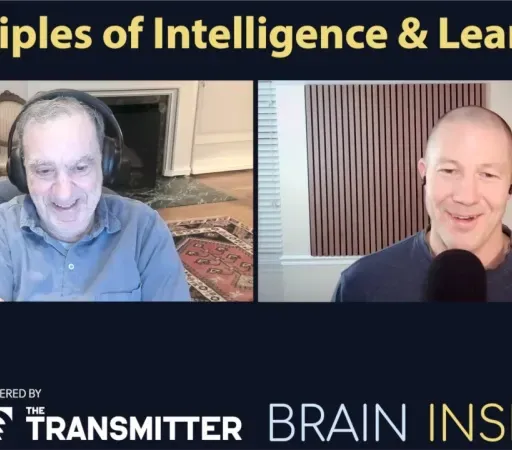
Tomaso Poggio is the Eugene McDermott professor in the Department of Brain and Cognitive Sciences, an investigator at the McGovern Institute for Brain Research, a member of the MIT Computer Science and Artificial Intelligence Laboratory (CSAIL) and director of both the Center for Biological and Computational Learning at MIT and the Center for Brains, Minds, and Machines.
Tomaso believes we are in-between building and understanding useful AI That is, we are in between engineering and theory. He likens this stage to the period after Volta invented the battery and Maxwell developed the equations of electromagnetism. Tomaso has worked for decades on the theory and principles behind intelligence and learning in brains and machines. I first learned of him via his work with David Marr, in which they developed "Marr's levels" of analysis that frame explanation in terms of computation/function, algorithms, and implementation. Since then Tomaso has added "learning" as a crucial fourth level. I will refer to you his autobiography to learn more about the many influential people and projects he has worked with and on, the theorems he and others have proved to discover principles of intelligence, and his broader thoughts and reflections.
Right now, he is focused on the principles of compositional sparsity and genericity to explain how deep learning networks can (computationally) efficiently learn useful representations to solve tasks.
Lab website.
Tomaso's Autobiography
Related papers
Position: A Theory of Deep Learning Must Include Compositional Sparsity
The Levels of Understanding framework, revised
Blog post:
Poggio lab blog.
The Missing Foundations of Intelligence
Read the transcript.
0:00 - Intro
9:04 - Learning as the fourth level of Marr's levels
12:34 - Engineering then theory (Volta to Maxwell)
19:23 - Does AI need theory?
26:29 - Learning as the door to intelligence
38:30 - Learning in the brain vs backpropagation
40:45 - Compositional sparsity
49:57 - Math vs computer science
56:50 - Generalizability
1:04:41 - Sparse compositionality in brains?
1:07:33 - Theory vs experiment
1:09:46 - Who needs deep learning theory?
1:19:51 - Does theory really help? Patreon
1:28:54 - Outlook