Support the show to get full episodes, full archive, and join the Discord community.
The Transmitter is an online publication that aims to deliver useful information, insights and tools to build bridges across neuroscience and advance research. Visit thetransmitter.org to explore the latest neuroscience news and perspectives, written by journalists and scientists.
Read more about our partnership.
Sign up for Brain Inspired email alerts to be notified every time a new Brain Inspired episode is released.
To explore more neuroscience news and perspectives, visit thetransmitter.org.
Can you look at all the synaptic connections of a brain, and tell me one nontrivial memory from the organism that has that brain? If so, you shall win the $100,000 prize from the Aspirational Neuroscience group.
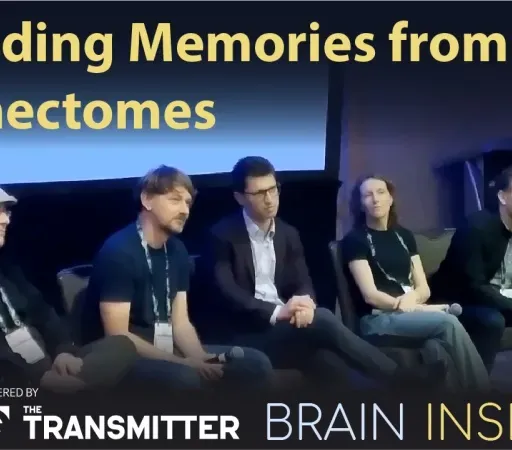
I was recently invited for the second time to chair a panel of experts to discuss that question and all the issues around that question - how to decode a non-trivial memory from a static map of synaptic connectivity.
Before I play that recording, let me set the stage a bit more.
Aspirational Neuroscience is a community of neuroscientists run by Kenneth Hayworth, with the goal, from their website, to "balance aspirational thinking with respect to the long-term implications of a successful neuroscience with practical realism about our current state of ignorance and knowledge." One of those aspirations is to decoding things - memories, learned behaviors, and so on - from static connectomes. They hold satellite events at the SfN conference, and invite experts in connectomics from academia and from industry to share their thoughts and progress that might advance that goal.
In this panel discussion, we touch on multiple relevant topics. One question is what is the right experimental design or designs that would answer whether we are decoding memory - what is a benchmark in various model organisms, and for various theoretical frameworks? We discuss some of the obstacles in the way, both technologically and conceptually. Like the fact that proofreading connectome connections - manually verifying and editing them - is a giant bottleneck, or like the very definition of memory, what counts as a memory, let alone a "nontrivial" memory, and so on. And they take lots of questions from the audience as well.
I apologize the audio is not crystal clear in this recording. I did my best to clean it up, and I take full blame for not setting up my audio recorder to capture the best sound. So, if you are a listener, I'd encourage you to check out the video version, which also has subtitles throughout for when the language isn't clear.
Anyway, this is a fun and smart group of people, and I look forward to another one next year I hope.
The last time I did this was episode 180, BI 180, which I link to in the show notes. Before that I had on Ken Hayworth, whom I mentioned runs Aspirational Neuroscience, and Randal Koene, who is on the panel this time. They were on to talk about the future possibility of uploading minds to computers based on connectomes. That was episode 103.
Aspirational Neuroscience
Panel
Michał Januszewski
- @michalwj.bsky.social
Research scientist (connectomics) with Google Research, automated neural tracing expert
Sven Dorkenwald
@sdorkenw.bsky.social
Research fellow at the Allen Institute, first-author on first full Drosophila connectome paper
Helene Schmidt
- @helenelab.bsky.social
Group leader at Ernst Strungmann Institute, hippocampus connectome & EM expert
Andrew Payne
@andrewcpayne.bsky.social
Founder of E11 Bio, expansion microscopy & viral tracing expert
Randal Koene
Founder of the Carboncopies Foundation, computational neuroscientist dedicated to the problem of brain emulation.
Related episodes:
BI 103 Randal Koene and Ken Hayworth: The Road to Mind Uploading
BI 180 Panel Discussion: Long-term Memory Encoding and Connectome Decoding