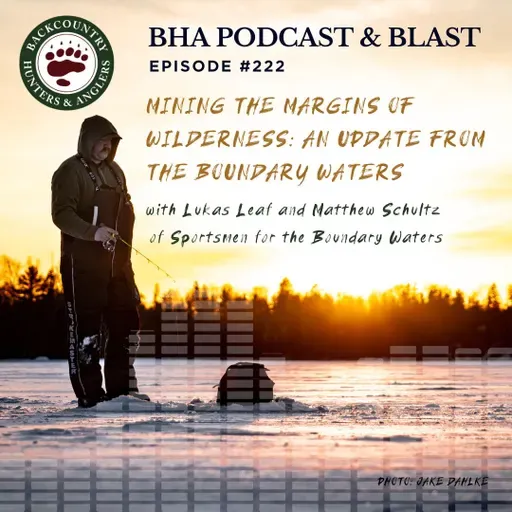
Mining the Margins of Wilderness: an Update from the Boundary Waters
Backcountry Hunters & Anglers Podcast & Blast with Hal Herring
BREAKING: Since this interview was recorded, a new attempt to permit a copper-nickel mine upstream of the Boundary Waters Canoe Area Wilderness is underway. On Monday, Jan. 12, Rep. Pete Stauber (R-Minn) introduced HJ Res. 140, which would lift the federal moratorium on mining in the Rainy River Watershed, just upstream from the wilderness border. Tell your elected officials to vote NO on HJ Res. 140 and any similar actions taken in the Senate, and call your elected officials directly on the Congressional Switchboard at (202) 224-3121.
The Boundary Waters Canoe Area Wilderness is a 1.1-million-acre expanse of lakes, rivers, and boreal forest—accessible only by paddle and portage—and one of the most intact wild places left in America. It's a world-class destination for fishing, hunting, camping, and solitude, but more than that, it's a place that shapes people. Generations of families, anglers, and paddlers have learned stewardship here, guided by a simple truth: some landscapes are priceless precisely because they demand restraint, responsibility, and care.
Today, that ethic is being tested. Proposed sulfide-ore mining at the doorstep of the Boundary Waters—backed by foreign mining interests and enabled by shifting federal policy—poses serious risks to a water-rich ecosystem that cannot absorb failure. This isn't just a Minnesota issue. It's a national question about how America balances resource extraction, public lands, and long-term economic reality against short-term gain. As administrations change, protections have ping-ponged, leaving this place—and others like it—perpetually on defense.
In this episode of the Backcountry Hunters & Anglers Podcast & Blast, host Hal Herring is joined by Lukas Leaf and Matthew Schultz of Sportsmen for the Boundary Waters to unpack what's really at stake. From the personal experiences that bind people to the Boundary Waters to the complex web of policy, permits, and public process governing its future, this conversation makes one thing clear: after today, none of us can say we didn't know.
Tell your elected officials to vote NO on HJ Res. 140 and any similar actions taken in the Senate, and call your elected officials directly on the Congressional Switchboard at (202) 224-3121.
The views and opinions expressed in the Podcast & Blast are those of the host and guests and do not necessarily reflect the official policy or position of Backcountry Hunters & Anglers.
The Podcast & Blast with Hal Herring is brought you by Backcountry Hunters & Anglers and presented by Silencer Central, with additional support from Decked, Dometic, and Filson.
Join Backcountry Hunters & Anglers, the voice for your wild public lands, waters, and wildlife to be part of a passionate community of hunter-angler-conservationists.
BHA. THE VOICE FOR OUR WILD PUBLIC LANDS, WATERS AND WILDLIFE.
Follow us:
Web: https://www.backcountryhunters.org
Instagram: @backcountryhunters
Facebook: @backcountryhunters