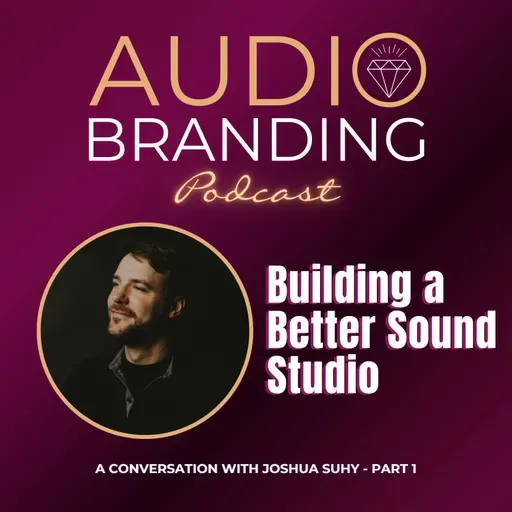
Building a Better Sound Studio: A Conversation with Joshua Suhy – Part 1
Audio Branding
“But from that point, it was just a matter of, okay, I’ve got to put all this kind of stuff together now. And now that there isn’t a moving image that I’m necessarily locked into, I wield more power in regards to molding the action, so I could decide how a scene breaks down. And I think the example that I had given to you was, if we have a scene where two characters are in a room or one character walks up to another one, I can decide, am I the character already in the room? Or am I the person outside of the room coming up to the other character? Because obviously those are two vastly different sound design approaches.” – Joshua Suhy
This week’s guest is the founder of JSS Audio and a veteran of over fifteen years in the audio industry as a Sound Designer, Audio Engineer and Producer. His goal is to capture the essence of creative people’s ideas and bring tangible experiences to their audiences. Helping people tell stories through sound is his passion. His name is Joshua Suhy, and we’ll be talking about the subtle power of audio, the unexpected moments that define a mix, and why even the smallest sound can shape how we experience a story. If you want to learn how sound can influence feeling, this episode’s for you.
As always, if you have questions for my guest, you’re welcome to reach out through the links in the show notes. If you have questions for me, visit audiobrandingpodcast.com, where you’ll find a lot of ways to get in touch. Plus, subscribing to the newsletter will let you know when the new podcasts are available, along with other interesting bits of audio-related news. And if you’re getting some value from listening, the best ways to show your support are to share this podcast with a friend and leave an honest review. Both those things really help, and I’d love to feature your review on future podcasts. You can leave one either in written or in voice format from the podcast’s main page. I would so appreciate that.
(00:00) - Using AI in Sound Design
Our conversation starts off with how Joshua has been putting AI to work for him in the studio, from finding gigs to helping manage his schedule. “One thing that I use it a lot for is to send me, like, a digest every morning of verified, paid, open audio gigs,” he explains. “I'm trying to use AI for the sake of what AI is supposed to do, [to] try to make my life easier.” He shares his early memories of sounds and the path that led him to become a sound engineer and producer, including a memorable sound editing project in his film class “Specifically it was the Bugs Bunny vs Elmer Fudd boxing match,” he says, “being able to blend real life sound effects, and we had the Hanna-Barbera sound library available at the school. So I'm like, I have [all] the stuff that I had always heard as a kid.”
(18:30) - Transition to Audio Production
The discussion turns to how the pandemic created a podcast boom that helped revolutionize audio and deepened Joshua’s approach to sound engineering. “Over time, we've changed it to where we wanna have full control over what's going on,” he tells us, “in regards to sending microphones out to people, sound checking people, making sure that they sound as good as possible, because I want the best quality coming in.” We talk about how audio standards loosened at the height of the pandemic as more people than ever before joined the podcasting sphere, and how technology has been working since to close the gap between home and work studios. “What I liked about it, though,” he explains, “was [how] it humanized podcasting and humanized the personalities... So being able to see, in an interview, somebody's child [walking] in the room, like these are people with real life situations.”
(25:00) - Impact of the Pandemic on Podcasting
As the first half of our conversation comes to a close, Joshua tells us about some of the podcasts he’s worked on that have left a big influence on him, such as the American Kennel Association’s Down & Back podcast. “Mike would write the script,” he says, “we would record Bud doing the voiceover, and then I just put everything together and build all the sound effects and music and all that kind of stuff in there, and they're just so much fun.” He shares his process for creating a Foley library of sound effects, and what he does when there isn’t a ready-made sound that fits his needs. “Footsteps, clothing sounds, things like that,” he says, “if I didn't have good cloth movement sounds, let's say, in my library, I would do my best to try to just shove a mic in front of my shirt and manipulate it that way.”
Episode Summary
- Exploring how Joshua utilizes ChatGPT for studio planning and finding new gigs.His career journey from music and cinema to audio post-production.How the pandemic changed the podcasting landscape and audio technology.
Be sure to tune in for next week’s episode as we talk about his work on branded podcasts, and what sets them apart from traditional podcasting, where he stands on licensed vs original music content, and why monetization shouldn’t necessarily be the starting goal of an up-and-coming podcast.
Connect with the Audio Branding Podcast:
Book your project with Voice Overs and Vocals by visiting https://voiceoversandvocals.com
Connect with me on Instagram - https://www.instagram.com/jodikrangle/
Watch the Audio Branding Podcast on YouTube - https://www.youtube.com/c/JodiKrangleVO
Connect with me on LinkedIn - https://www.linkedin.com/in/jodikrangle/
Leave the Audio Branding Podcast a review at https://lovethepodcast.com/audiobranding (Thank you!)
Share your passion effectively with these Tips for Sounding Your Best as a Podcast Guest!
https://voiceoversandvocals.com/tips-for-sounding-your-best-as-a-podcast-guest/
Get my Top Five Tips for Implementing an Intentional Audio Strategy
https://voiceoversandvocals.com/audio-branding-strategy/
Editing/Production by Humberto Franco - https://humbertofranco.com/
This podcast uses the following third-party services for analysis:
OP3 - https://op3.dev/privacy