Please note an important mistake on the original post! As a state, Iowa missed out on $200 Million Annually (it is listed here as the total amount) on money that would have been allocated from IWILL had it been funded. That means roughly $3-4 Billion Dollars over the 16 years since voters voted for the fund.
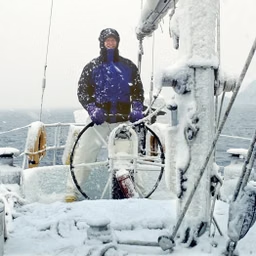
David Thoreson is an adventurer who has spent a large portion of his life at sea.
He has learned critical lessons—in the Arctic and at his home of Okoboji—about how we impact the world around us. And, he knows first hand, we need to make important changes, now.
In this special episode of At the Iowa Farm Table, Beth Hoffman combines Thoreson’s photography (and other images) with the usual audio podcast to create a video experience. In it she looks how and why agriculture in our state needs to improve, and the ways one community has done so.
Below is a transcript of the podcast if you prefer to read.
It profoundly changed my life
David Thoreson: I something was happening–dramatic–but I was not mentally prepared for what I witnessed,
Beth Hoffman: David Thoreson is an Iowan, an explorer and an avid conservationist. He witnessed firsthand something most of us have not.
DT: It profoundly changed my life.
BH Thoreson has experienced climate change in action–a story we will get into detail a little later. But he also knows what solutions to a warming climate look like, because he’s experienced that too–in his community of the Iowa Great Lakes, also known as Okoboji.
I’m Beth Hoffman, journalist, author and farmer. And this is Season III of At the Iowa Farm Table, a production of the Iowa Food System Coalition, a group of more than 60 organizations in Iowa working to make the food system more sustainable and just.
DT: I was a very active kid. I liked being outside…playing by the river all the time, making forts and building caves…And my grandfather loved sailboats and had a big library that was full of nautical books…I started developing a dream to go sail around the world as, really as a boy
.
BH: It took a while for Thoreson to figure out how to get on a sailboat. In the meantime, his adventurous spirit took him around the world as a young man.
DT: I rebuilt a bicycle and toured around South Pacific islands and slept in huts with native village people and went to New Zealand. I rode 1,300 miles, and then hitchhiked through Australia. I kept doing adventures, and then at some point, I came back here to Okoboji in the ‘80s and started a freelance photography business based on conservation and outdoor photography.
BH: Upon his return, Thoreson got more involved with his com b munity. He joined the city council and later, helped start the Dickinson County Water Quality Commission. Such activism was in his blood. His grandfather had been the president of Okoboji Protective Association, one of the oldest environmental groups in Iowa, started in 1905.
DT People would come up here by train, and…they would camp on the lake shore. So you can you can understand that that wasn’t very sanitary as far as human waste. Then there was also the pressure of animals and farming on the lake shore.
BH: People living on the lake realized early on that they needed an organization to deal with the water quality of the lake.
DT: The water quality movement here in the lakes area has been very progressive, even ahead of state and national trends…And so part of the push early on was to form partnerships both with the local farming community and also with our neighbors…because we understood that as long as we could keep these lakes clear, that it drove the economy.
BH: Conservation wasn’t just good for the flora and fauna, it was good for the economy. So the Association created a tax authority to raise money for water quality and recreational initiatives.
Many Iowans have long supported a similar statewide initiative–the Natural Resources and Outdoor Recreation Trust Fund (also known as IWILL). Iowa voters overwhelmingly passed a ⅜ cent sales tax increase in 2010 that at this point would have generated more than $200 million for Iowa’s water and land. But the legislature never funded it.
The Okoboji tax authority is a local version and a model for how a statewide program is supposed to work.
DT: We’ve used a lot of the funds to purchase property to restore wetlands, and grasslands, and a lot of prairie around the lakes area.
BH: But what the tax shows is that people can work together for a common goal–clean water. They even work together to make sure animal confinement stays away from the lake.
DT: And we’ve done that strictly by peer pressure…W hen we hear of anything, we kind of get going and we do this in a bipartisan way. It’s something I call the Okoboji Model…When we need to do things to protect the lakes and the water, we work together to do it.
BH: But even though his work at Okoboji was rewarding, that dream of sailing never left him.
DT: I just really wanted to get on the ocean. But I’m from Iowa, you know?...I had heard of this farmer who lived up in Minnesota…His name was Roger Swanson.
So I went up and he said, “Well, meet me in Cape Town a year from now.” ..So, I loaded up my backpack and all my camera gear and eventually found the boat and off I went, sailing across the South Atlantic Ocean. 6,000 miles, 38 days nonstop, was my first adventure on the ocean.
DT: I sailed with him for 16 years. 45,000 miles around the planet and to both poles….And the more I got out there on the ocean, the more I started thinking about weather and climate systems. I used my water quality community knowledge here of Okoboji and watersheds, I met scientists who were working, and then I started photographing and documenting these things.
BH: Thoreson made four documentary films for Iowa PBS about his travels. But it was his work on the last film that changed his life. On that trip he tackled the Northwest Passage–a lane from the Atlantic to the Pacific, along the Arctic Circle.
DT: It had been a goal of mine to get through the Northwest Passage for 15 years.
BH: He tried to sail it in 1994, but the ice blocked his way. Then the winter of 2007 was one of the warmest on record. He decided to try to sail the passage again that summer.
DT: And so when I went up there that year, I expected to see lots of loss of ice But I was not mentally prepared for what I witnessed, to actually see the ice just disintegrate and melt and go away. We were able to go 6,694 miles all the way through in 73 days in one season, which was unheard of. It was a record, you know, like nobody had ever done this.
DT: It was the most profoundly feeling of sadness…what I saw in those 13 years, from 1994 to 2007, I witnessed was a 40% loss of our entire North Pole ice on planet Earth. And if we were looking at another planet out there in our solar system and said, “Wow, look at what’s happening. This planet is losing their entire polar ice cap,” we’d be freaked out. But it’s our planet.
BH: The issue with ice melting is that it took millenia to build up. Thick, sea ice, is white and reflects sunlight–in a process called albedo- which in turn helps cool our planet. It’s what keeps our planet at a temperature good for humans, and keeps our weather patterns stable enough to do basic things like grow food. Now there is very little of it left.
DT: I’m almost in a panic mode every single day. It’s like my burden that I carry because I witnessed a planetary tipping point, and I just want to shout it out as loud as I can to the world, Like, “People,” like, “we’re destroying this beautiful thing, this gift that, that we’ve been given, you know, to live life on this planet.”
BH: Witnessing the destruction of the planet has had a profound impact on Thoreson’s life. And yet so has the positive work he has seen in Okoboji. He has witnessed bi-partisan solutions to improving water quality, creating trails and reestablishing wetlands and prairie. But he also knows how much more we might have accomplished had the public fund IWILL been funded.
DT: Because we never funded that trust fund, IWILL...Everyone comes to the Iowa Great Lakes because we spent millions and millions of dollars to build these amenities here, which is great. I mean, we love it. But the lakes aren’t getting any bigger, and the stress with the number of boats and the people that are out here now is kind of getting maxed out. In a sense, we’re kind of loving the water to death.
BH: Thoreson says towns need to understand that investing in the health of water through practices like buffer strips and cover crops, and making quality parks and trails–it makes areas more desirable, especially for young families who seem to be flocking to the Okoboji area. Since 2010 rural counties around the US that invested in recreational activities grew, while those without them shrunk on average by 20%. Investing in lakes to swim in and trails to walk, it turns out, is not just nice. It is a viable economic strategy.
DT: Outdoor recreation, which many people don’t even know, is a $7 billion industry in the state of Iowa with 80,000 employees. Why don’t we add to that and maybe rein agriculture in some around the edges, and expand our economy in different ways?
BH: On average, an acre of corn in 2026 will make a farmer about a hundred dollars, at best. That same acre, particularly land around lakes and streams, next to rural towns and along rivers, could be much more valuable to the community if something else was done there.
It’s true–Iowa is an agricultural state. But we also have to learn from our mistakes and ensure that farming in our state takes care of the lakes, our families, and our planet.
Very special thanks to David Thoreson. If you would like to hear more about his adventures, learn more about how and why ice is melting in the Arctic, and how Okoboji has worked to protect Iowa’s Great Lakes region–you can listen to the entire interview on substack or YouTube.
You’ve been listening to At the Iowa Farm Table, a production of the Iowa Food System Coalition. Read the transcript of this interview or send it to a friend on our substack
The full interview will be posted in the next day.
This is a public episode. If you would like to discuss this with other subscribers or get access to bonus episodes, visit attheiowafarmtable.substack.com