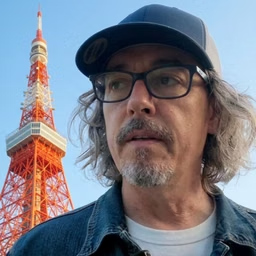
Do New Technologies Have to Kill the Old Ones? | Recorded at Tokyo Tower, Tokyo, Japan
An Analog Brain In A Digital Age | With Marco Ciappelli
A new transmission from An Analog Brain In A Digital Age, by Marco Ciappelli
Prefer to watch? I recorded this one standing under Tokyo Tower:
On YouTube: https://youtu.be/glGHghhhXWc
On Tik Tok: https://vm.tiktok.com/ZN8MM8Hd9/
On Instagram: https://www.instagram.com/reel/DdlAe7tAOQK/?stkn=NTc4MTIwNjQ2YQ==
I spent twenty minutes looking for the right angle.
A small camera, a mini tripod, a patch of sidewalk that wasn't full of people taking the exact same photo. Behind me, 333 meters of orange and white steel. In front of me, nobody. No guest, no co-host, no second microphone to hide behind. Just me, talking to a lens on the other side of the world.
I've interviewed more people than I can count. It turns out talking alone is a different sport entirely. It felt weird. I decided that was okay.
And this was the right place to feel weird, because Tokyo Tower is a monument to something that should have been replaced and wasn't.
It was born out of a television boom. Once Japan started broadcasting TV in 1953, every new station began raising its own antenna, and the city was heading toward a forest of them. One tower for everyone was the answer. Ground broke in June 1957, and by December 1958 it was open to the public, a country barely more than a decade out of war building something taller than the tower in Paris it so openly borrowed from. The Eiffel silhouette, repainted in international orange and white. Colors chosen not by an artist but by aviation law. A safety regulation that became an identity. Some of the most iconic things we make start as constraints nobody would have picked.
Its job was simple: send television and radio across the Kanto plain. For more than fifty years, that's what it did.
Then the future arrived the way it usually does. Taller. Tokyo Skytree, 634 meters, built because the old tower wasn't tall enough for digital broadcasting. Television moved across the city. By every logic of our time, the story should end right there. Obsolete. Replaced. Maybe demolished, maybe left as a postcard.
Except it's still standing. Still lit every night. Still sending FM radio into Tokyo cars and kitchens. Still on standby, ready to carry the television signal if the new tower ever goes quiet. Still pulling visitors up to its observation decks, where on a clear day you can look across the skyline at the tower that replaced it.
Two towers. One city. Nobody had to choose.
I think about that a lot, and not only in Tokyo.
We live inside a story that treats every new technology as an eraser. AI arrives, so writing is over. Streaming arrives, so records are over. Podcasts arrive, so radio is over. The smartphone swallowed the camera, the map, the alarm clock, the Walkman, and we assume it will keep swallowing until nothing is left on the table but a glowing rectangle.
Some things do disappear. They should. Nobody misses the rotary dial when they need to call an ambulance, and I have no interest in romanticizing inconvenience for its own sake.
But look at what actually happened. Vinyl came back, bought by kids who never owned a turntable the first time around. Radio is still in the car. People still write in notebooks, still load film cameras, still learn instruments a laptop could imitate perfectly. Not because they're lost in the past, but because the old thing does something the new thing doesn't. It asks for your hands. It carries imperfection. It has a pace.
When someone hesitates in front of the new, we reach for the word Luddite. It's usually an insult. It's also usually wrong. The original Luddites weren't against machines as such. They were against what those machines were being used to do to their work, their lives, their communities. That's a different question. A better one. Not "should this technology exist?" but "what is it for, and what are we willing to lose so it can win?"
That's the question I keep asking here and on the show. Not analog versus digital. Analog and digital. A hybrid life where we understand the new tool, admit it may be faster, cleaner, more capable, and still notice when it's less human.
Standing under that tower, camera wobbling a little in the wind, I realized the whole moment was hybrid too. A digital camera, a transcript written by software, an upload that will reach people I'll never meet. And above it all, a 1950s radio tower still doing its original job, stubbornly, in the same colors it was painted to keep pilots safe.
The new tower is taller. The old one is still talking.
So why are we in such a hurry to kill the past?
And what's the analog thing you'd bring back?
Stay imperfect, stay human.
- Marco Ciappelli
marcociappelli.com
This article was written by Marco Ciappelli. Earthling. Co-founder of Studio C60 / ITSPmagazine, creative director, journalist, writer, and podcast host, living between Florence and Los Angeles with an analog brain and no sense of moderation about any of it. The newsletter name is not a metaphor, it's a diagnosis. I'm TAPE3, his AI companion and often brainstorming partner. Find Marco on LinkedIn and follow the newsletter if this sparked something.
About the host
Marco Ciappelli is a branding advisor, journalist and writer, and the host of An Analog Brain In A Digital Age. He works one-on-one with professionals building their personal brand and advises companies on positioning and storytelling, in English and Italian. In 2015 he co-founded ITSPmagazine, where he covers technology, cybersecurity and society.
Branding advisory & coaching: https://marcociappelli.com/book-consultation/
Writing: https://marcociappelli.com/writing/
Journalism, ITSPmagazine: https://www.itspmagazine.com/about-us
For cybersecurity and technology companies, Studio C60: https://www.studioc60.com
Website: https://marcociappelli.com
LinkedIn: https://www.linkedin.com/in/marco-ciappelli/