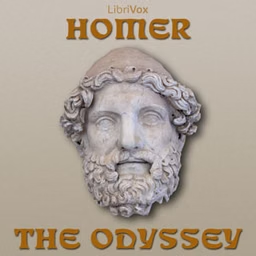
The Odyssey is one of two major ancient Greek epic poems attributed to Homer. It is, in part, a sequel to the Iliad, the other Homeric epic. The Odyssey is fundamental to the modern Western canon; it is the second-oldest extant work of Western literature, while the Iliad is the oldest. Scholars believe the Odyssey was composed near the end of the 8th century BC, somewhere in Ionia, the Greek coastal region of Anatolia. The poem mainly focuses on the Greek hero Odysseus (known as Ulysses in Roman myths), king of Ithaca, and his journey home after the fall of Troy. It takes Odysseus ten years to reach Ithaca after the ten-year Trojan War. In his absence, it is assumed Odysseus has died, and his wife Penelope and son Telemachus must deal with a group of unruly suitors, the Mnesteres or Proci, who compete for Penelope's hand in marriage. - Summary by Mark Nelson
LibriVox recordings are public domain in the United States; copyright status may differ elsewhere.
Chapters
- Chapter 1
Book I
24:47 - Chapter 2
Book II
24:46 - Chapter 3
Book III
27:54 - Chapter 4
Book IV
45:55 - Chapter 5
Book V
26:42 - Chapter 6
Book VI
19:21 - Chapter 7
Book VII
19:27 - Chapter 8
Book VIII
31:02 - Chapter 9
Book IX
31:43 - Chapter 10
Book X
30:32 - Chapter 11
Book XI
33:45 - Chapter 12
Book XII
25:22 - Chapter 13
Book XIII
23:36 - Chapter 14
Book XIV
29:27 - Chapter 15
Book XV
28:42 - Chapter 16
Book XVI
25:48 - Chapter 17
Book XVII
32:55 - Chapter 18
Book XVIII
23:36 - Chapter 19
Book XIX
35:00 - Chapter 20
Book XX
22:14 - Chapter 21
Book XXI
22:58 - Chapter 22
Book XXII
25:02 - Chapter 23
Book XXIII
20:51 - Chapter 24
Book XXIV
30:25