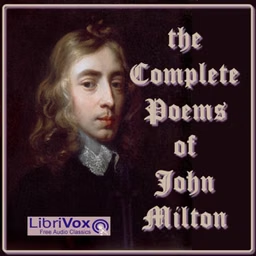
It is by his poetry that Milton is best known; and it is of his poetry that we wish first to speak. By the general suffrage of the civilized world, his place has been assigned among the greatest masters of the art... No poet has ever triumphed over greater difficulties than Milton. He received a learned education: he was a profound and elegant classical scholar: he had studied all the mysteries of rabbinical literature: he was intimately acquainted with every language in modern Europe from which either pleasure or information was then to be derived. He was perhaps the only poet of later times who has been distinguished by the excellence of his Latin verse.
The most striking characteristic of the poetry of Milton is the extreme remoteness of the associations by means of which it acts on the reader. Its effect is produced, not so much by what it expresses, as by what it suggests; not so much by the ideas which it directly conveys, as by other ideas which are connected with them. He electrifies the mind through conductors. The most unimaginative man must understand the Iliad. Homer gives him no choice, and requires from him no exertion, but takes the whole upon himself, and sets the images in so clear a light that it is impossible to be blind to them. The works of Milton cannot be comprehended or enjoyed unless the mind of the reader cooperate with that of the writer. He does not paint a finished picture, or play for a mere passive listener. He sketches, and leaves others to fill up the outline. He strikes the key-note, and expects his hearer to make out the melody.
We often hear of the magical influence of poetry. The expression in general means nothing ; but, applied to the writings of Milton, it is most appropriate. His poetry acts like an incantation. Its merit lies less in its obvious meaning than in its occult power. There would seem at first sight, to be no more in his words than in other words. But they are words of enchantment. No sooner are they pronounced, than the past is present and the distant near. New forms of beauty start at once into existence, and all the burial-places of the memory give up their dead. Change the structure of the sentence; substitute one synonyme for another, and the whole effect is destroyed. - Summary by John Lord
The most striking characteristic of the poetry of Milton is the extreme remoteness of the associations by means of which it acts on the reader. Its effect is produced, not so much by what it expresses, as by what it suggests; not so much by the ideas which it directly conveys, as by other ideas which are connected with them. He electrifies the mind through conductors. The most unimaginative man must understand the Iliad. Homer gives him no choice, and requires from him no exertion, but takes the whole upon himself, and sets the images in so clear a light that it is impossible to be blind to them. The works of Milton cannot be comprehended or enjoyed unless the mind of the reader cooperate with that of the writer. He does not paint a finished picture, or play for a mere passive listener. He sketches, and leaves others to fill up the outline. He strikes the key-note, and expects his hearer to make out the melody.
We often hear of the magical influence of poetry. The expression in general means nothing ; but, applied to the writings of Milton, it is most appropriate. His poetry acts like an incantation. Its merit lies less in its obvious meaning than in its occult power. There would seem at first sight, to be no more in his words than in other words. But they are words of enchantment. No sooner are they pronounced, than the past is present and the distant near. New forms of beauty start at once into existence, and all the burial-places of the memory give up their dead. Change the structure of the sentence; substitute one synonyme for another, and the whole effect is destroyed. - Summary by John Lord
LibriVox recordings are public domain in the United States; copyright status may differ elsewhere.
Chapters
- Chapter 1
On the Morning of Christ's Nativity
16:48 - Chapter 2
Paraphrase on Psalm CXIV
02:15 - Chapter 3
Psalm CXXXVI
06:28 - Chapter 4
On the Death of a Fair Infant Dying of a Cough
06:26 - Chapter 5
At a Vacation Exercise in the College, Part Latin, Part English
05:56 - Chapter 6
The Passion
05:17 - Chapter 7
On Shakespeare
01:57 - Chapter 8
On the University Carrier
02:14 - Chapter 9
Another on the Same
02:50 - Chapter 10
An Epitaph on the Marchioness of Winchester
04:32 - Chapter 11
On His Being Arrived to the Age of Twenty-Three
01:31 - Chapter 12
L'Allegro
07:41 - Chapter 13
Il Penseroso
08:51 - Chapter 14
Sonnet to the Nightingale
01:37 - Chapter 15
Song on May Morning
01:31 - Chapter 16
On Time
01:53 - Chapter 17
At a Solemn Music
02:51 - Chapter 18
Upon the Circumcision
02:46 - Chapter 19
Arcades
06:51 - Chapter 20
Comus, a Mask Part 1
26:01 - Chapter 21
Comus, a Mask Part 2
27:52 - Chapter 22
Lycidas
10:13 - Chapter 23
When the Assault Was Intended to the City
01:50 - Chapter 24
To a Virtuous Young Lady
01:33 - Chapter 25
To the Lady Margaret Ley
01:52 - Chapter 26
On the Detraction Which Followed Upon My Writing Certain Treatises
01:55 - Chapter 27
On the Same
01:49 - Chapter 28
On the New Forcers of Conscience Under the Long Parliament
01:46 - Chapter 29
To Mr H. Lawes on His Airs
01:51 - Chapter 30
On the Religious Memory of Mrs Catherine Thomson, My Christian Friend, Deceased Dec 16, 1646
01:21 - Chapter 31
On the Lord General Fairfax at the Siege of Colchester
01:29 - Chapter 32
To the Lord General Cromwell, on the Proposals of Certain Ministers at the Committee for the Propagation of the Gospel
01:59 - Chapter 33
To Sir Henry Vane the Younger
01:45 - Chapter 34
On the Late Massacre in Piemont
01:32 - Chapter 35
On His Blindness
01:36 - Chapter 36
To Mr Lawrence
01:22 - Chapter 37
To Cyriack Skinner
01:18 - Chapter 38
To the Same
01:19 - Chapter 39
On His Deceased Wife
01:53 - Chapter 40
Paradise Lost: the First Book Part 1
20:55 - Chapter 41
Paradise Lost: the First Book Part 2
31:37 - Chapter 42
Paradise Lost: the Second Book Part 1
31:30 - Chapter 43
Paradise Lost: the Second Book Part 2
34:24 - Chapter 44
Paradise Lost: the Third Book
47:25 - Chapter 45
Paradise Lost: the Fourth Book Part 1
32:20 - Chapter 46
Paradise Lost: the Fourth Book Part 2
29:53 - Chapter 47
Paradise Lost: the Fifth Book Part 1
29:39 - Chapter 48
Paradise Lost: the Fifth Book Part 2
27:47 - Chapter 49
Paradise Lost: the Sixth Book Part 1
35:36 - Chapter 50
Paradise Lost: the Sixth Book Part 2
24:54 - Chapter 51
Paradise Lost: the Seventh Book
37:43 - Chapter 52
Paradise Lost: the Eighth Book
32:34 - Chapter 53
Paradise Lost: the Ninth Book Part 1
28:04 - Chapter 54
Paradise Lost: the Ninth Book Part 2
39:12 - Chapter 55
Paradise Lost: the Tenth Book Part 1
30:34 - Chapter 56
Paradise Lost: the Tenth Book Part 2
34:57 - Chapter 57
Paradise Lost: the Eleventh Book Part 1
28:45 - Chapter 58
Paradise Lost: the Eleventh Book Part 2
23:48 - Chapter 59
Paradise Lost: the Twelfth Book
36:40 - Chapter 60
Paradise Regained: the First Book
31:49 - Chapter 61
Paradise Regained: the Second Book
31:25 - Chapter 62
Paradise Regained: the Third Book
29:55 - Chapter 63
Paradise Regained: the Fourth Book
41:33 - Chapter 64
Milton's Introduction to Samson Agonistes
05:52 - Chapter 65
Samson Agonistes, 1667—1671 Part 1
33:15 - Chapter 66
Samson Agonistes, 1667—1671 Part 2
40:11 - Chapter 67
Samson Agonistes, 1667—1671 Part 3
29:46