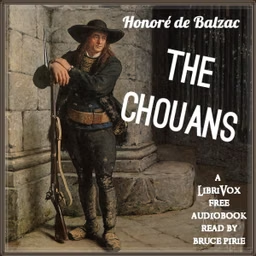
“The Chouans” (1829) was the first novel published under Balzac’s own name (rather than a pen-name). It became the first book in the great work of his lifetime — the novel series titled “The Human Comedy.”
Balzac was impressed by the writings of Sir Walter Scott. Scott made Scottish history come alive by creating fictions that used real history as backdrop. Balzac’s novel is set in 1799 — the year that Napoleon became First Consul of France. In the far west of France (i.e., Brittany), anti-revolutionary sentiment still simmered. The Chouans were a rustic guerrilla militia who wanted to undo the French Revolution and restore the old Bourbon monarchy. Pitted against them were the forces of the new Republic and its military (“the Blues”). Balzac researched this historical period as well as living conditions for Bretons of that time, then wove into the actual history his own fictional account of a romance between lovers from opposite factions in the dispute.
In “The Chouans,” we see an early and influential example of “historical fiction,” a genre which blossomed in popularity during the 1800s, and remains popular in today’s novels and films. - Summary by Bruce Pirie
Balzac was impressed by the writings of Sir Walter Scott. Scott made Scottish history come alive by creating fictions that used real history as backdrop. Balzac’s novel is set in 1799 — the year that Napoleon became First Consul of France. In the far west of France (i.e., Brittany), anti-revolutionary sentiment still simmered. The Chouans were a rustic guerrilla militia who wanted to undo the French Revolution and restore the old Bourbon monarchy. Pitted against them were the forces of the new Republic and its military (“the Blues”). Balzac researched this historical period as well as living conditions for Bretons of that time, then wove into the actual history his own fictional account of a romance between lovers from opposite factions in the dispute.
In “The Chouans,” we see an early and influential example of “historical fiction,” a genre which blossomed in popularity during the 1800s, and remains popular in today’s novels and films. - Summary by Bruce Pirie
LibriVox recordings are public domain in the United States; copyright status may differ elsewhere.
Chapters
- Chapter 1
Chapter 1.a The Ambuscade
38:48 - Chapter 2
Chapter 1.b
33:15 - Chapter 3
Chapter 1.c
39:57 - Chapter 4
Chapter 1.d
27:39 - Chapter 5
Chapter 1.e
31:15 - Chapter 6
Chapter 2.a A Notion of Fouché's
30:29 - Chapter 7
Chapter 2.b
35:30 - Chapter 8
Chapter 2.c
27:22 - Chapter 9
Chapter 2.d
30:29 - Chapter 10
Chapter 2.e
37:07 - Chapter 11
Chapter 2.f
37:29 - Chapter 12
Chapter 2.g
44:00 - Chapter 13
Chapter 2.h
35:07 - Chapter 14
Chapter 2.i
28:08 - Chapter 15
Chapter 2.j
30:35 - Chapter 16
Chapter 3.a A Day Without a Morrow
33:33 - Chapter 17
Chapter 3.b
38:21 - Chapter 18
Chapter 3.c
30:34 - Chapter 19
Chapter 3.d
28:33 - Chapter 20
Chapter 3.e
39:18 - Chapter 21
Chapter 3.f
35:26 - Chapter 22
Chapter 3.g
25:37 - Chapter 23
Chapter 3.h
44:19 - Chapter 24
Chapter 3.i
28:15 - Chapter 25
Chapter 3.j
29:25 - Chapter 26
Chapter 3.k
26:59 - Chapter 27
Chapter 3.l
20:26 - Chapter 28
Chapter 3.m
32:38 - Chapter 29
Chapter 3.n
34:56