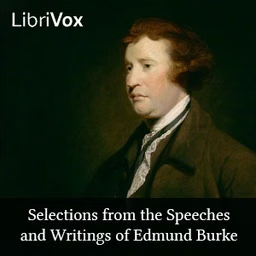
There can be no hesitation in according to him a station among the most extraordinary men that ever appeared; and we think there is now but little diversity of opinion as to the kind of place which it is fit to assign him. He was a writer of the first class, and excelled in almost every kind of composition. Possessed of most extensive knowledge, and of the most various description; acquainted alike with what different classes of men knew, each in his own province, and with much that hardly any one ever thought of learning; he could either bring his masses of information to bear directly upon the subjects to which they severally belonged,—or he could avail himself of them generally to strengthen his faculties, and enlarge his views,—or he could turn any of them to account for the purpose of illustrating his theme, or enriching his diction. Hence, when he is handling any one matter, we perceive that we are conversing with a reasoner or a teacher, to whom almost every other branch of knowledge is familiar: his views range over all the cognate objects; his reasonings are derived from principles applicable to other themes, as well as the one in hand; arguments pour in from all sides, as well as those which start up under our feet,—the natural growth of the path he is leading us over; while to throw light round our steps, and either explore its darkest places, or serve for our recreation; illustrations are fetched from a thousand quarters, and an imagination marvelously quick to descry unthought of resemblances, points to our use the stores, which a love yet more marvelously has gathered from all ages and nations, and arts and tongues. - Summary by Sir James Mackintosh
LibriVox recordings are public domain in the United States; copyright status may differ elsewhere.
Chapters
- Chapter 1
Introductory Essay
38:05 - Chapter 2
Appendix
04:40 - Chapter 3
Nature and Functions of the House of Commons — Retrospect and Resignation — Modesty of Mind — Newton and Nature — Theory and Practice
08:41 - Chapter 4
Induction and Comparison — Divine Power on the Human Idea — Union of Love and Dread in Religion — Office of Sympathy — Words
05:45 - Chapter 5
Nature Anticipates Man — Self — Inspection — Power of the Obscure — Female Beauty — Novelty and Curiosity
04:48 - Chapter 6
Pleasures of Analogy — Ambition — Extensions of Sympathy — Philosophy of Taste — Clearness and Strength in Style
05:12 - Chapter 7
Unity of Imagination — Effect of Words — Investigation — Sublime — Obscurity
04:52 - Chapter 8
Principles of Taste — the Beautiful — the Real and the Ideal — Judgment in Art — Moral Effects of Language
07:45 - Chapter 9
Security of Truth — Imitation an Instinctive Law — Standard of Reason and Taste — Use of Theory — Political Outcasts
05:36 - Chapter 10
Injustice to Our Own Age — False Coalitions — Political Empiricism — a Visionary — Party Divisions
06:35 - Chapter 11
Decorum in Party — not So Bad as We Seem — Politics Without Principle — Moral Debasement Progressive — Despotism
06:08 - Chapter 12
Judgment and Policy — Popular Discontent — the People and Their Rulers — Government Favouritism — Administration and Legislation
06:00 - Chapter 13
Influence of the Crown — Voice of the People — Fallacy of Extremes — Private Character a Basis for Public Confidence — Prevention
08:28 - Chapter 14
Confidence in the People — False Maxims Assumed as First Principles — Lord Chatham — Grenville — Charles Townshend
16:31 - Chapter 15
Party and Place — Political Connections — Neutrality — Weakness in Government — American Progress
10:05 - Chapter 16
Combination, not Faction — Great Men — Power of Constituents — Influence of Place in Government — Taxation Involves Principle
07:10 - Chapter 17
Good Member of Parliament — Fisheries of New England — Preparation for Parliament — Bathurst and America's Future — Candid Policy
10:28 - Chapter 18
Wisdom of Concession — Magnanimity — Duty of Representatives — Prudential Silence — Colonial Ties
04:52 - Chapter 19
Government and Legislation — Parliament — Moral Levellers — Public Salary and Patriotic Service — Rational Liberty
08:42 - Chapter 20
Ireland and Magna Charta — Colonies and British Constitution — Reciprocal Confidence — Pensions and the Crown — Colonial Progress
12:31 - Chapter 21
Feudal Principles and Modern Times — Restrictive Virtues — Libellers of Human Nature — Refusal a Revenue — a Party Man
11:35 - Chapter 22
Patriotism and Public Income — American Protestantism — Right of Taxation — Contracted Views — Assimilating Power of Contact
09:42 - Chapter 23
Prudence of Timely Reform — Difficulties of Reformers — Philosophy of Commerce — Theorizing Politicians — Economy and Public Spirit
08:35 - Chapter 24
Reform Ought to Be Progressive — Civil Freedom — Tendencies of Power — Individual Good and Public Benefit — Public Corruption
07:00 - Chapter 25
Cruelty and Cowardice — Bad Laws Produce Base Subserviency — False Regret — British Dominion in East India — Political Charity
12:20 - Chapter 26
Evils of Distraction — Charles Fox — the Impracticable Undesirable — Constitution of the Commons — Emoluments of Office
10:21 - Chapter 27
Moral Distinctions — Electors and Representatives — Popular Opinion a Fallacious Standard — English Reformation — Proscription
10:21 - Chapter 28
Just Freedom — England's Embassy to America — Howard, the Philanthropist — Parliamentary Retrospect — People and Parliament
08:09 - Chapter 29
Reformed Civil List — French and English Revolution — Armed Discipline — Gilded Despotism — Our French Dangers
10:59 - Chapter 30
Sir George Saville — Corruption not Self — Reformed — the Bribed and the Bribers — Hyder Ali — Reformation and Anarchy Contrasted and Compared
14:14 - Chapter 31
Confidence and Jealousy — Economy of Injustice — Subsistence and Revenue — Authority and Venality — Prerogative of the Crown and Privilege of Parliament
09:24 - Chapter 32
Burke and Fox — Peers and Commons — Natural Self — Destruction — the Carnatic — Abstract Theory of Human Liberty
14:08 - Chapter 33
Politics and the Pulpit — Idea of French Revolution — Patriotic Distinction — Kingly Power not Based on Popular Choice — Preaching Democracy of Dissent
12:10 - Chapter 34
Jargon of Republicanism — Conservative Progress of Inherited Freedom — Conservation and Correction — Hereditary Succession of English Crown — Limits of Legislative Capacity
16:25 - Chapter 35
Our Constitution, not Fabricated, But Inherited — Low Aims and Low Instruments — House of Commons Contrasted with National Assembly — Property, More Than Ability, Represented in Parliament — Virtue and Wisdom Qualify for Government
22:17 - Chapter 36
Natural and Civil Rights — Marie Antoinette — Spirit of a Gentleman and the Spirit of Religion — Power Survives Opinion — Chivalry a Moralizing Charm
21:46 - Chapter 37
Sacredness of Moral Instincts — Parental Experience — Revolutionary Scene — Economy on State Principles — Philosophical Vanity; Its Maxims, and Effects
41:22 - Chapter 38
Unity Between Church and State — Triple Basis of French Revolution — Correspondent System of Manners and Morals — Ferocity of Jacobinism — Voice of Oppression
19:31 - Chapter 39
Britain Vindicated in Her War with France — Polish and French Revolution — Europe in 1789 — Atheism Cannot Repent — Outward Dignity of the Church Defended
20:38 - Chapter 40
Danger of Abstract Views — Appeal to Impartiality — Historical Estimate of Louis Xvi — Negative Religion a Nullity — Antechamber of Regicide
14:45 - Chapter 41
Tremendousness of War — English Officers — Diplomacy of Humiliation — Relation of Wealth to National Dignity — Ambassadors of Infamy
13:34 - Chapter 42
Difficulty the Path to Glory — Robespierre and His Counterparts — Accumulation, a State Principle — Warning for a Nation — Santerre and Tallien
17:16 - Chapter 43
Sir Sydney Smith — a Moral Distinction — Infidels and Their Policy — What a Minister Should Attempt — Law of Vicinity
21:20 - Chapter 44
European Community — Perils of Jacobin Peace — Parliamentary and Regal Prerogative — Burke's Design in His Greatest Work — Lord Keppel
24:36 - Chapter 45
"Labouring Poor" — State Consecrated by the Church — Fate of Louis XVIII — Nobility — Legislation and Republicans
22:49 - Chapter 46
Principle of State-Consecration — British Stability — Literary Atheists — City of Paris — Principle of Church Property
23:20 - Chapter 47
Parsimony not Economy — Majesty of the British Constitution — Duty not Based on Will — Ecclesiastical Confiscation — Moral of History
17:34 - Chapter 48
Use of Defects in History — Social Contract — Prescriptive Rights — Madness of Innovation — the State, Its Own Revenue
16:11 - Chapter 49
Metaphysical Depravity — Personal and Ancestral Claims — Monastic and Philosophic Superstition — Difficulty and Wisdom of Corporate Reform — Distinctive Character of English Protestantism
18:24 - Chapter 50
Fictitious Liberty — French Ignorance of English Character — the "People," and "Omnipotence" of Parliament — Magnanimity of English People — True Basis of Civil Society
13:11 - Chapter 51
Rousseau — Moral Heroes — Kingdom of France — Grievance and Opinion — Perplexity and Policy
13:49 - Chapter 52
Historical Instruction — Montesquieu — Articles, and Scripture — Problem of Legislation — Order, Labour, and Property
10:31 - Chapter 53
Regicidal Legislature — Government not to Be Rashly Censured — Etiquette — Ancient Establishments — Sentiment and Policy
10:51 - Chapter 54
Patriotism — Necessity, a Relative Term — King John and the Pope — Consumption and Produce — "Priests of the Rights of Man"
13:12 - Chapter 55
"His Grace" — Speculation and History — Labour and Wages — a Complete Revolution — British Government in India
27:15 - Chapter 56
Money and Science — Political Axioms — Disappointed Ambition — Difficulty an Instructor — Sovereign Jurisdictions
22:28 - Chapter 57
Prudery of False Reform — Exaggeration — Tactics of Cabal — Government, Relative, not Absolute — General Views
21:04 - Chapter 58
Magnitude in Building — Society and Solitude — East — India Bill and Company — Parliaments and Elections — Religion and Magistracy
28:35 - Chapter 59
Persecution, False in Theory — Irish Legislation — Henry of Navarre — Test Acts — What Faction Ought to Teach
11:21 - Chapter 60
Grievances by Law — Revolutionary Politics — Toleration Become Intolerant — Wilkes and Right of Election — Rockingham and Conway
30:27 - Chapter 61
Politics in the Pulpit — William the Conqueror — King Alfred — Druids — Saxon Conquest and Conversion
32:59 - Chapter 62
Ministerial Responsibility — Monastic Institutions and Their Results — Common Law and Magna Charta — Europe and the Norman Invasion — Ancient Inhabitants of Britain
57:01 - Chapter 63
Public Prosecutions — True Nature of a Jacobin War — National Dignity — Principles of Government not Absolute, But Relative — Declaration of 1793
27:08 - Chapter 64
Moral Diet — King William's Policy — Distemper of Remedy — War and Will of the People — False Policy in Our French War
18:09 - Chapter 65
Moral Essence Makes a Nation — Public Spirit — Progressive Growth of Christian States — Petty Interests — Pius Vii
16:47 - Chapter 66
Extinction of Local Patriotism — Walpole and His Policy — Political Peace — Public Loans — Historical Strictures
31:01 - Chapter 67
Constitution not the People's Slave — Modern "Lights" — Republics in the Abstract — an English Monarch — Physiognomy
14:08 - Chapter 68
The Eye — Abolition and Use of Parliaments — Cromwell and His Contrasts — Delicacy — Confiscation and Currency
23:24 - Chapter 69
"Omnipotence of Church Plunder" — Ugliness — Grace — Elegance and Speciousness — the Beautiful in Feeling
09:25 - Chapter 70
The Beautiful in Sounds — British Church
08:47