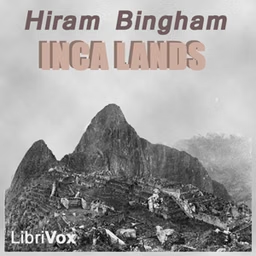
Prof. Hiram Bingham of Yale Makes the Greatest Archaeological Discovery of the Age by Locating and Excavating Ruins of Machu Picchu on a Peak in the Andes of Peru.
There is nothing new under the sun, they say. That is only relatively true. Just now, when we thought there was practically no portion of the earth's surface still unknown, when the discovery of a single lake or mountain, or the charting of a remote strip of coast line was enough to give a man fame as an explorer, one member of the daredevil explorers' craft has "struck it rich." Struck it so dazzlingly rich, indeed, that all his confrères may be pardoned if they gnash their teeth in chagrin and turn green with envy. The lucky man is Prof. Hiram Bingham of Yale, he whose hobby is South America. He has just announced that he has had the superb good fortune to discover an entire city, two thousand years old, a place of splendid palaces and temples and grim encircling walls, hidden away so thoroughly on the top of a well-nigh inaccessible mountain peak of the Peruvian Andes that the Spanish invaders of four hundred years ago never set eyes upon it. He calls it Machu Picchu. (From New York Times, June 15, 1913)
One hundred years ago in the summer of 1911, Bingham discovered Machu Picchu, returning in the summer of 1912 to excavate under the auspices of Yale and The National Geographic Society, and coming home to great acclaim and a spate of published articles and photos. He fully described the 1911 expedition and original find in his 1922 book INCA LANDS: Explorations in the Highlands of Peru.
(Summary by New York Times and ToddHW)
There is nothing new under the sun, they say. That is only relatively true. Just now, when we thought there was practically no portion of the earth's surface still unknown, when the discovery of a single lake or mountain, or the charting of a remote strip of coast line was enough to give a man fame as an explorer, one member of the daredevil explorers' craft has "struck it rich." Struck it so dazzlingly rich, indeed, that all his confrères may be pardoned if they gnash their teeth in chagrin and turn green with envy. The lucky man is Prof. Hiram Bingham of Yale, he whose hobby is South America. He has just announced that he has had the superb good fortune to discover an entire city, two thousand years old, a place of splendid palaces and temples and grim encircling walls, hidden away so thoroughly on the top of a well-nigh inaccessible mountain peak of the Peruvian Andes that the Spanish invaders of four hundred years ago never set eyes upon it. He calls it Machu Picchu. (From New York Times, June 15, 1913)
One hundred years ago in the summer of 1911, Bingham discovered Machu Picchu, returning in the summer of 1912 to excavate under the auspices of Yale and The National Geographic Society, and coming home to great acclaim and a spate of published articles and photos. He fully described the 1911 expedition and original find in his 1922 book INCA LANDS: Explorations in the Highlands of Peru.
(Summary by New York Times and ToddHW)
LibriVox recordings are public domain in the United States; copyright status may differ elsewhere.
Chapters
- Chapter 1
01 - Crossing the Desert, part 1
21:34 - Chapter 2
02 - Crossing the Desert, part 2
20:39 - Chapter 3
03 - Climbing Coropuna, part 1
29:11 - Chapter 4
04 - Climbing Coropuna, part 2
23:29 - Chapter 5
05 - To Parinacochas, part 1
20:48 - Chapter 6
06 - To Parinacochas, part 2
22:29 - Chapter 7
07 - Flamingo Lake, part 1
16:47 - Chapter 8
08 - Flamingo Lake, part 2
21:58 - Chapter 9
09 - Titicaca
28:53 - Chapter 10
10 - The Vilcanota Country and the Peruvian Highlanders, part 1
17:32 - Chapter 11
11 - The Vilcanota Country and the Peruvian Highlanders, part 2
21:11 - Chapter 12
12 - The Valley of the Huatanay, part 1
21:00 - Chapter 13
13 - The Valley of the Huatanay, part 2
22:07 - Chapter 14
14 - The Oldest City in South America
22:47 - Chapter 15
15 - The Last Four Incas, part 1
22:20 - Chapter 16
16 - The Last Four Incas, part 2
26:31 - Chapter 17
17 - Searching for the Last Inca Capital, part 1
15:58 - Chapter 18
18 - Searching for the Last Inca Capital, part 2
15:17 - Chapter 19
19 - The Search Continued, part 1
20:45 - Chapter 20
20 - The Search Continued, part 2
15:37 - Chapter 21
21 - The Fortress of Uiticos and the House of the Sun
24:17 - Chapter 22
22 - Vilcabamba
19:42 - Chapter 23
23 - Conservidayoc, part 1
23:31 - Chapter 24
24 - Conservidayoc, part 2
18:06 - Chapter 25
25 - The Pampa of Ghosts
21:18 - Chapter 26
26 - The Story of Tampu-tocco, a Lost City of the First Incas
13:16 - Chapter 27
27 - Machu Picchu
21:46 - Chapter 28
28 - The Origin of Machu Picchu
26:04