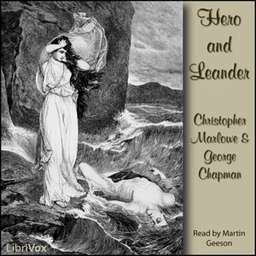
“Who ever lov’d, that lov’d not at first sight?”
The wonder-decade of the English drama was suddenly interrupted in 1592, when serious plague broke out in London, forcing the closure of the theatres. Leading playwrights took to penning languorously erotic poetry to make ends meet: so we have Venus and Adonis, The Rape of Lucrece - and Marlowe’s blazing masterpiece, Hero and Leander.
Marlowe’s poem became more notorious than either of Shakespeare’s, due not only to its homophile provocations but also to the scandal attaching to every aspect of Marlowe’s brief life, violently ended in a mysterious brawl, leaving the poem in an unfinished state.
The edition read here includes the wonderful continuation by George Chapman, a versatile playwright: tragedian as well as author of Jonsonian metropolitan comedies: in short, an all-round literary craftsman, whose Homer translation was famously admired by Keats. Chapman excels in extended allegory, but also in pithiest epigram –
“Love is a golden bubble, full of dreams,
That waking breaks, and fills us with extremes.”
All these playwrights come from the generation of grammar-school alumni raised on the secular curriculum of Latin poetry: above all, Ovid – the source of the story of Hero and Leander, and their “love-death” in the Hellespont.
(Summary by Martin Geeson)
The wonder-decade of the English drama was suddenly interrupted in 1592, when serious plague broke out in London, forcing the closure of the theatres. Leading playwrights took to penning languorously erotic poetry to make ends meet: so we have Venus and Adonis, The Rape of Lucrece - and Marlowe’s blazing masterpiece, Hero and Leander.
Marlowe’s poem became more notorious than either of Shakespeare’s, due not only to its homophile provocations but also to the scandal attaching to every aspect of Marlowe’s brief life, violently ended in a mysterious brawl, leaving the poem in an unfinished state.
The edition read here includes the wonderful continuation by George Chapman, a versatile playwright: tragedian as well as author of Jonsonian metropolitan comedies: in short, an all-round literary craftsman, whose Homer translation was famously admired by Keats. Chapman excels in extended allegory, but also in pithiest epigram –
“Love is a golden bubble, full of dreams,
That waking breaks, and fills us with extremes.”
All these playwrights come from the generation of grammar-school alumni raised on the secular curriculum of Latin poetry: above all, Ovid – the source of the story of Hero and Leander, and their “love-death” in the Hellespont.
(Summary by Martin Geeson)
LibriVox recordings are public domain in the United States; copyright status may differ elsewhere.
Chapters
- Chapter 1
00 - Printer's Dedication
03:39 - Chapter 2
01 - First Sestiad, part one
15:37 - Chapter 3
02 - First Sestiad, part two
18:25 - Chapter 4
03 - First Sestiad, part three
08:57 - Chapter 5
04 - Second Sestiad, part one
17:32 - Chapter 6
05 - Second Sestiad, part two
12:46 - Chapter 7
06 - Third Sestiad, part one
17:58 - Chapter 8
07 - Third Sestiad, part two
19:20 - Chapter 9
08 - Fourth Sestiad, part one
19:32 - Chapter 10
09 - Fourth Sestiad, part two
12:08 - Chapter 11
10 - Fifth Sestiad, part one
11:14 - Chapter 12
11 - Fifth Sestiad, part two
12:44 - Chapter 13
12 - Fifth Sestiad, part three
06:57 - Chapter 14
13 - Fifth Sestiad, part four
12:27 - Chapter 15
14 - Sixth Sestiad, part one
14:20 - Chapter 16
15 - Sixth Sestiad, part two
13:31