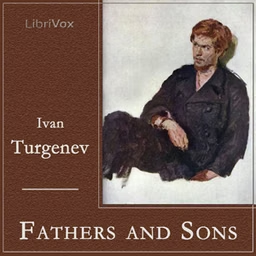
The fathers and children of the novel refers to the growing divide between the two generations of Russians, and the character Yevgeny Bazarov has been referred to as the "first Bolshevik", for his nihilism and rejection of the old order.
Turgenev wrote Fathers and Sons as a response to the growing cultural schism that he saw between liberals of the 1830s/1840s and the growing nihilist movement. Both the nihilists (the "sons") and the 1830s liberals sought Western-based social change in Russia. Additionally, these two modes of thought were contrasted with the conservative Slavophiles, who believed that Russia's path lay in its traditional spirituality.
Fathers and Sons might be regarded as the first wholly modern novel in Russian Literature (Gogol's Dead Souls, another main contender, is sometimes referred to as a poem or epic in prose as in the style of Dante's Divine Comedy). The novel introduces a dual character study, as seen with the gradual breakdown of Bazarov's and Arkady's nihilistic opposition to emotional display, especially in the case of Bazarov's love for Madame Odintsova and Fenichka. This prominent theme of character duality and deep psychological insight would exert an influence on most of the great Russian novels to come, most obviously echoed in the novels of Tolstoy and Dostoevsky.
The novel is also the first Russian work to gain prominence in the Western world, eventually gaining the approval of well established novelists Gustave Flaubert, Guy de Maupassant, and Henry James, proving that Russian literature owes much to Ivan Turgenev. (Summary from Wikipedia)
Turgenev wrote Fathers and Sons as a response to the growing cultural schism that he saw between liberals of the 1830s/1840s and the growing nihilist movement. Both the nihilists (the "sons") and the 1830s liberals sought Western-based social change in Russia. Additionally, these two modes of thought were contrasted with the conservative Slavophiles, who believed that Russia's path lay in its traditional spirituality.
Fathers and Sons might be regarded as the first wholly modern novel in Russian Literature (Gogol's Dead Souls, another main contender, is sometimes referred to as a poem or epic in prose as in the style of Dante's Divine Comedy). The novel introduces a dual character study, as seen with the gradual breakdown of Bazarov's and Arkady's nihilistic opposition to emotional display, especially in the case of Bazarov's love for Madame Odintsova and Fenichka. This prominent theme of character duality and deep psychological insight would exert an influence on most of the great Russian novels to come, most obviously echoed in the novels of Tolstoy and Dostoevsky.
The novel is also the first Russian work to gain prominence in the Western world, eventually gaining the approval of well established novelists Gustave Flaubert, Guy de Maupassant, and Henry James, proving that Russian literature owes much to Ivan Turgenev. (Summary from Wikipedia)
LibriVox recordings are public domain in the United States; copyright status may differ elsewhere.
Chapters
- Chapter 1
Chapter 01
09:49 - Chapter 2
Chapter 02
05:07 - Chapter 3
Chapter 03
14:40 - Chapter 4
Chapter 04
11:35 - Chapter 5
Chapter 05
16:16 - Chapter 6
Chapter 06
08:05 - Chapter 7
Chapter 07
16:54 - Chapter 8
Chapter 08
18:52 - Chapter 9
Chapter 09
08:06 - Chapter 10
Chapter 10
32:32 - Chapter 11
Chapter 11
10:52 - Chapter 12
Chapter 12
13:39 - Chapter 13
Chapter 13
16:02 - Chapter 14
Chapter 14
12:44 - Chapter 15
Chapter 15
11:56 - Chapter 16
Chapter 16
26:51 - Chapter 17
Chapter 17
29:39 - Chapter 18
Chapter 18
13:19 - Chapter 19
Chapter 19
19:33 - Chapter 20
Chapter 20
29:21 - Chapter 21
Chapter 21
43:45 - Chapter 22
Chapter 22
15:16 - Chapter 23
Chapter 23
18:02 - Chapter 24
Chapter 24
45:00 - Chapter 25
Chapter 25
27:08 - Chapter 26
Chapter 26
23:34 - Chapter 27
Chapter 27
41:45 - Chapter 28
Chapter 28
15:01