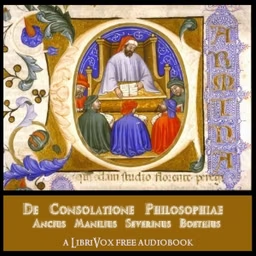
Consolation of Philosophy (Latin: Consolatio Philosophiae) is a philosophical work by Boethius written in about the year 524 AD. It has been described as the single most important and influential work in the West in medieval and early Renaissance Christianity, and is also the last great work that can be called Classical.
Consolation of Philosophy was written during Boethius' one year imprisonment while awaiting trial, and eventual horrific execution, for the crime of treason by Ostrogothic King Theodoric the Great. Boethius was at the very heights of power in Rome and was brought down by treachery. It was from this experience he was inspired to write a philosophical book from prison reflecting on how a lord's favor could change so quickly and why friends would turn against him. It has been described as “by far the most interesting example of prison literature the world has ever seen.”
The Consolation of Philosophy stands, by its note of fatalism and its affinities with the Christian doctrine of humility, midway between the heathen philosophy of Seneca the Younger and the later Christian philosophy of consolation represented by Thomas Aquinas.
The book is heavily influenced by Plato and his dialogues (as was Boethius himself). - Summary by Wikipedia
Consolation of Philosophy was written during Boethius' one year imprisonment while awaiting trial, and eventual horrific execution, for the crime of treason by Ostrogothic King Theodoric the Great. Boethius was at the very heights of power in Rome and was brought down by treachery. It was from this experience he was inspired to write a philosophical book from prison reflecting on how a lord's favor could change so quickly and why friends would turn against him. It has been described as “by far the most interesting example of prison literature the world has ever seen.”
The Consolation of Philosophy stands, by its note of fatalism and its affinities with the Christian doctrine of humility, midway between the heathen philosophy of Seneca the Younger and the later Christian philosophy of consolation represented by Thomas Aquinas.
The book is heavily influenced by Plato and his dialogues (as was Boethius himself). - Summary by Wikipedia
LibriVox recordings are public domain in the United States; copyright status may differ elsewhere.
Chapters
- Chapter 1
Liber I: a principio usque ad prosam III inclusive
15:08 - Chapter 2
Liber I: a metro IV usque ad finem
28:52 - Chapter 3
Liber II: a principio usque ad metrum IV inclusive
25:49 - Chapter 4
Liber II: a prosa V usque ad finem
29:43 - Chapter 5
Liber III: a principio usque ad metrum V inclusive
26:07 - Chapter 6
Liber III: a prosa VI usque ad metrum IX inclusive
20:31 - Chapter 7
Liber III: a prosa X usque ad finem
35:12 - Chapter 8
Liber IV: a principio usque ad metrum IV inclusive
39:07 - Chapter 9
Liber IV: a prosa V usque ad finem
30:27 - Chapter 10
Liber V: a principio usque ad metrum III inclusive
20:34 - Chapter 11
Liber V: a prosa IV usque ad finem
33:00