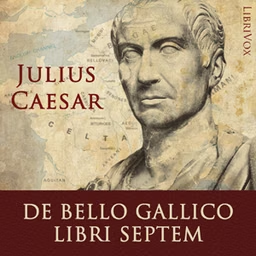
In this book the famous Gaius Julius Caesar himself describes the seven years of his war in Gaul.
When Caesar got proconsul of Gallia and Illyria in 58 B.C, the conquest of land in Gaul was an urgent need, both to improve his political standing and to calm his creditors in Rome. So Caesar claims his interest for a very large area already in the first sentence.
His steps and measures always appear clear and logical, but this simplicity is the result of a strict discipline in style. Caesar really chooses his words, and the list of standard words that he never or rarely uses, is astonishing. E.g. for "river" he only uses flumen and never fluvius or amnis. He avoids porro (furthermore), which would be no decided beginning of a sentence, and in his writings never occurs the word clades (the defeat), although this would normally be demanded by the context.
It is remarkable, that still today in all the lands of his conquest the word for "peace" is derived from latin pax (even basque "bake"). This peace is no friendship between equals, which is the idea behind the German word "Friede". Pax Romana implies subordination, and this concept was promoted by Caesar, first abroad and then at home. (Summary by Marilianus)
When Caesar got proconsul of Gallia and Illyria in 58 B.C, the conquest of land in Gaul was an urgent need, both to improve his political standing and to calm his creditors in Rome. So Caesar claims his interest for a very large area already in the first sentence.
His steps and measures always appear clear and logical, but this simplicity is the result of a strict discipline in style. Caesar really chooses his words, and the list of standard words that he never or rarely uses, is astonishing. E.g. for "river" he only uses flumen and never fluvius or amnis. He avoids porro (furthermore), which would be no decided beginning of a sentence, and in his writings never occurs the word clades (the defeat), although this would normally be demanded by the context.
It is remarkable, that still today in all the lands of his conquest the word for "peace" is derived from latin pax (even basque "bake"). This peace is no friendship between equals, which is the idea behind the German word "Friede". Pax Romana implies subordination, and this concept was promoted by Caesar, first abroad and then at home. (Summary by Marilianus)
LibriVox recordings are public domain in the United States; copyright status may differ elsewhere.
Chapters
- Chapter 1
01 - Book I ch.1-9
17:00 - Chapter 2
02 - Book I ch.10-15
12:48 - Chapter 3
03 - Book I ch.16-29
19:50 - Chapter 4
04 - Book I ch.30-41
31:12 - Chapter 5
05 - Book I ch.42-54
26:44 - Chapter 6
06 - Book II ch.1-15
27:13 - Chapter 7
07 - Book II ch.16-34
34:18 - Chapter 8
08 - Book III ch.1-16
24:49 - Chapter 9
09 - Book III ch.17-28
18:56 - Chapter 10
10 - Book IV ch.1-15
21:35 - Chapter 11
11 - Book IV ch.16-19
08:06 - Chapter 12
12 - Book IV ch.20-38
34:29 - Chapter 13
13 - Book V ch.1-14
27:33 - Chapter 14
14 - Book V ch.15-23
14:57 - Chapter 15
15 - Book V ch.24-37
21:50 - Chapter 16
16 - Book V ch.38-57
32:53 - Chapter 17
17 - Book VI ch.1-8
13:17 - Chapter 18
18 - Book VI ch.9-28
27:58 - Chapter 19
19 - Book VI ch.29-44
24:44 - Chapter 20
20 - Book VII ch.1-13
19:24 - Chapter 21
21 - Book VII ch.14-28
24:51 - Chapter 22
22 - Book VII ch.29-41
21:17 - Chapter 23
23 - Book VII ch.42-51
14:24 - Chapter 24
24 - Book VII ch.52-71
37:56 - Chapter 25
25 - Book VII ch.72-90
38:07