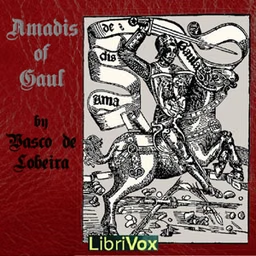
Amadis of Gaul (Amadís de Gaula, in Spanish) was not the first, but certainly one of the best known knight-errantry tales of the 16th century. Not only is its authorship doubtful, but even the language in which it was first written - Portuguese or Spanish. It is imagined to have been composed in the 14th century, but the known first printed edition came to light in Zaragoza in 1508, and the oldest extant version is in Spanish.
The plot is the story of the brave knight Amadis, and starts with the forbidden love of his parents and his secret birth, followed by his abandonment near water. He is found and raised as the son of a knight. Upon reaching adulthood, he goes in a quest for his own identity, and investigates his origins through fantastic adventures: plenty of wizards, princesses, damsels in distress and other knights people the world of Amadis.
Amadis of Gaul, together with Palmerin of England and Tirante the White, are the only books saved from the fire by Quixote's curate, when purging the knight's library: Tirante, for its quaintness; Palmerin, because he thought it had been written by the king himself; and Amadis, for being the best of its kind. Even if Cervante's praise works more as censure, it's a fact that Amadis represents the style as no other, and was the father of a numerous flock, becoming a landmark work among the knight-errantry tales and marking the story of European literature. (Summary by Leni)
Dedicated Proof-Listeners: Miss Stav, Becky Cook, & Rapunzelina
The plot is the story of the brave knight Amadis, and starts with the forbidden love of his parents and his secret birth, followed by his abandonment near water. He is found and raised as the son of a knight. Upon reaching adulthood, he goes in a quest for his own identity, and investigates his origins through fantastic adventures: plenty of wizards, princesses, damsels in distress and other knights people the world of Amadis.
Amadis of Gaul, together with Palmerin of England and Tirante the White, are the only books saved from the fire by Quixote's curate, when purging the knight's library: Tirante, for its quaintness; Palmerin, because he thought it had been written by the king himself; and Amadis, for being the best of its kind. Even if Cervante's praise works more as censure, it's a fact that Amadis represents the style as no other, and was the father of a numerous flock, becoming a landmark work among the knight-errantry tales and marking the story of European literature. (Summary by Leni)
Dedicated Proof-Listeners: Miss Stav, Becky Cook, & Rapunzelina
LibriVox recordings are public domain in the United States; copyright status may differ elsewhere.
Chapters
- Chapter 1
00 - Preface
35:58 - Chapter 2
01 - Book 1, Chapters 1 - 2
16:44 - Chapter 3
02 - Book 1, Chapters 3 - 4
24:03 - Chapter 4
03 - Book 1, Chapters 5 - 6
22:18 - Chapter 5
04 - Book 1, Chapters 7 - 9
25:17 - Chapter 6
05 - Book 1, Chapters 10 - 11
16:44 - Chapter 7
06 - Book 1, Chapters 12 - 13
35:26 - Chapter 8
07 - Book 1, Chapters 14 - 16
31:30 - Chapter 9
08 - Book 1, Chapters 17 - 18
21:48 - Chapter 10
09 - Book 1, Chapters 19 - 21
34:12 - Chapter 11
10 - Book 1, Chapters 22 - 24
26:44 - Chapter 12
11 - Book 1, Chapters 25 - 29
38:19 - Chapter 13
12 - Book 1, Chapters 30 - 33
24:29 - Chapter 14
13 - Book 1, Chapters 34 - 35
37:04 - Chapter 15
14 - Book 1, Chapters 36 - 37
21:52 - Chapter 16
15 - Book 1, Chapters 38 - 40
24:13 - Chapter 17
16 - Book 1, Chapters 41 - 42
23:55 - Chapter 18
17 - Book 1, Chapters 43 - 44
34:35 - Chapter 19
18 - Book 2, Chapters 1 - 3
34:03 - Chapter 20
19 - Book 2, Chapters 4 - 5
14:17 - Chapter 21
20 - Book 2, Chapters 6 - 7
28:30 - Chapter 22
21 - Book 2, Chapters 8 - 9
28:35 - Chapter 23
22 - Book 2, Chapters 10 - 11
21:29 - Chapter 24
23 - Book 2, Chapters 12 - 13
39:54 - Chapter 25
24 - Book 2, Chapters 14 - 15
37:27 - Chapter 26
25 - Book 2, Chapter 16
27:23 - Chapter 27
26 - Book 2, Chapters 17 - 18
39:40 - Chapter 28
27 - Book 2, Chapter 19
40:51 - Chapter 29
28 - Book 2, Chapter 20
26:23 - Chapter 30
29 - Book 2, Chapter 21
23:46 - Chapter 31
30 - Book 2, Chapter 22
31:38 - Chapter 32
31 - Book 3, Chapter 1
31:23 - Chapter 33
32 - Book 3, Chapter 2
24:53 - Chapter 34
33 - Book 3, Chapter 3
22:40 - Chapter 35
34 - Book 3, Chapter 4
20:17 - Chapter 36
35 - Book 3, Chapter 5
39:39 - Chapter 37
36 - Book 3, Chapter 6
32:51 - Chapter 38
37 - Book 3, Chapter 7
30:53 - Chapter 39
38 - Book 3, Chapters 8 - 9
31:58 - Chapter 40
39 - Book 3, Chapter 10
31:21 - Chapter 41
40 - Book 3, Chapter 11
30:19 - Chapter 42
41 - Book 3, Chapter 12
27:32 - Chapter 43
42 - Book 3, Chapter 13
23:28 - Chapter 44
43 - Book 3, Chapter 14
17:22 - Chapter 45
44 - Book 3, Chapter 15
24:41 - Chapter 46
45 - Book 3, Chapter 16
20:08 - Chapter 47
46 - Book 3, Chapter 17
31:30 - Chapter 48
47 - Book 3, Chapter 18
14:06 - Chapter 49
48 - Book 4, Chapters 1 - 5
34:27 - Chapter 50
49 - Book 4, Chapters 6 - 12
31:05 - Chapter 51
50 - Book 4, Chapters 13 - 15
34:57 - Chapter 52
51 - Book 4, Chapters 16 - 18
28:55 - Chapter 53
52 - Book 4, Chapters 19 - 24
36:48 - Chapter 54
53 - Book 4, Chapters 25 - 27
22:49 - Chapter 55
54 - Book 4, Chapter 28
20:38 - Chapter 56
55 - Book 4, Chapters 29 - 30
33:20 - Chapter 57
56 - Book 4, Chapters 31 - 33
33:07 - Chapter 58
57 - Book 4, Chapters 34 - 35
23:46 - Chapter 59
58 - Book 4, Chapter 36
37:55 - Chapter 60
59 - Book 4, Chapters 37 - 40
34:50 - Chapter 61
60 - Book 4, Chapter 41
17:03 - Chapter 62
61 - Book 4, Chapters 42 - 44
23:48